Hard-to-fit contacts in New Albany, Ohio.
If you've walked away from contacts more than once (uncomfortable lenses, blurry vision that never quite sharpened, or a flat-out "we can't fit you" from another provider), you're not unusual, and you're probably not unfittable. Most patients who get told "no" got told "no" by someone working with a limited toolkit. A specialty contact lens fit starts from a different place: your exact corneal shape, your specific diagnosis, and lens designs built around eyes that don't behave the way standard contacts expect.
At COVE, we use corneal topography, anterior segment imaging, and a set of lens platforms that most general practices don't carry. The goal isn't to force a standard lens onto a non-standard eye. It's to find the design that was made for your eye.
What "hard to fit" actually means.
Getting told you're "hard to fit" isn't a diagnosis. It's a description of a fitting attempt that ran out of options. Standard contact lenses are made to fit a statistical average of human corneas. When your cornea falls outside that average (because of its shape, curvature, surface condition, or the prescription it needs to correct), a standard lens can't land on it properly.
The result is usually one of three things: the lens moves and vision fluctuates, the lens is so uncomfortable you give up wearing it, or the provider simply says they can't fit you. None of those outcomes means contacts aren't possible. They mean the lens that was tried wasn't the right one.
Five reasons contacts haven't worked.
The "hard to fit" label gets attached to a handful of underlying conditions. Each one has a specific reason why standard lenses fail, and a specific category of specialty lens that addresses it.
Irregular cornea
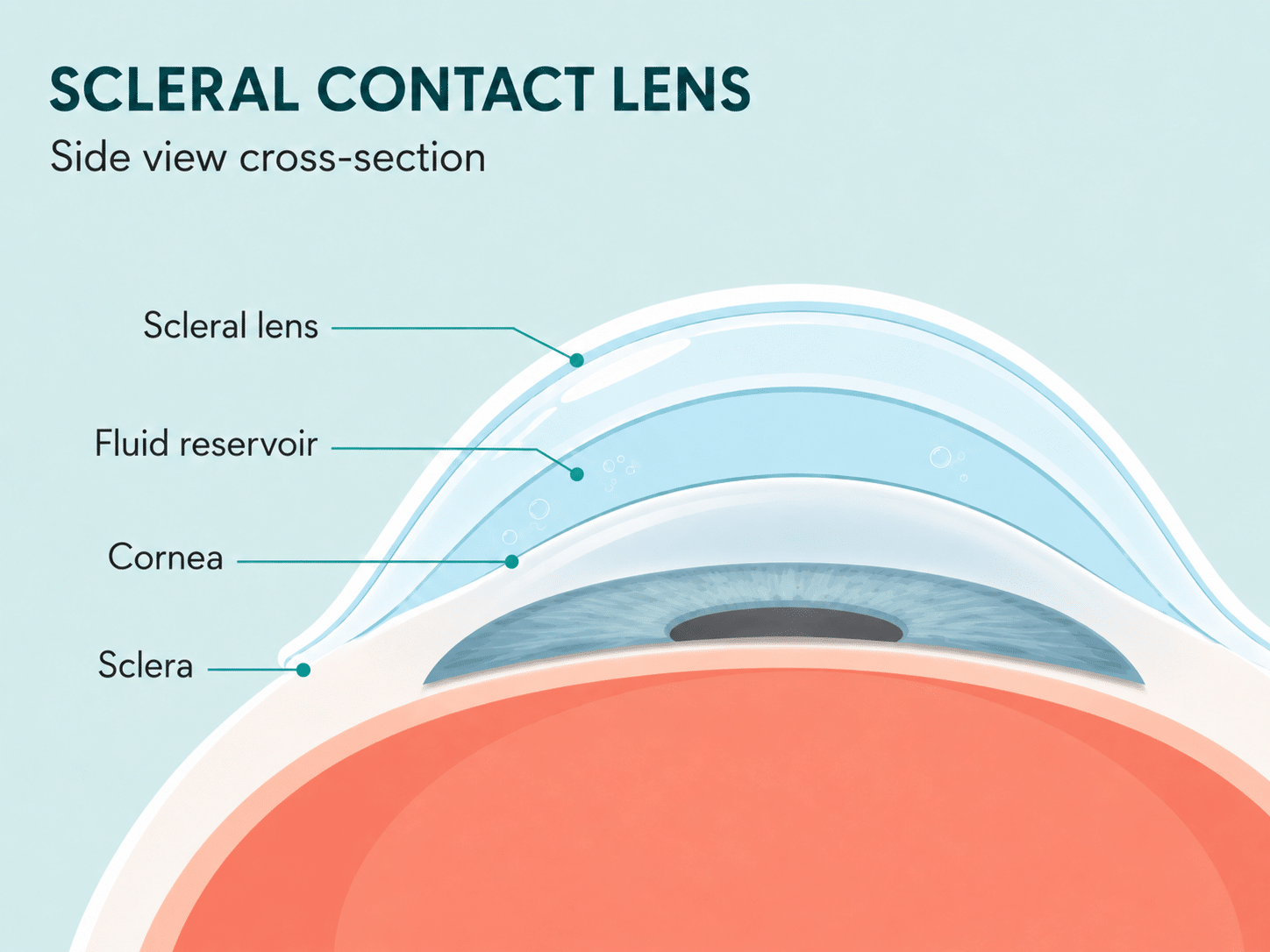
Keratoconus, corneal scars, and most post-surgical irregularities create a surface that a standard soft lens can't cover in a way that corrects the distortion. The lens needs to vault or bridge the irregularity rather than drape across it. Scleral lenses for keratoconus →
Severe dry eye
Standard soft lenses pull moisture from the tear film throughout the day. For patients with dry eye disease, that creates a cycle of discomfort and lens intolerance by midday. Scleral lenses carry their own fluid reservoir and never touch the cornea, which changes the equation entirely.
Post-LASIK or post-surgical corneas
LASIK, RK, PRK, and corneal transplants change the shape of the cornea in ways that make standard fitting difficult or impossible. Specialty lenses are designed around the actual surface, not a paper prescription. Sclerals for irregular corneas →
High myopia, hyperopia, or astigmatism
Very high prescriptions require tighter tolerances and better centration than standard soft lenses provide. A lens that shifts or flexes with each blink delivers unstable vision all day. Custom-designed rigid and scleral lenses hold their position and their prescription.
Contact lens intolerance: cause unknown
Some patients have tried multiple brands, multiple materials, and multiple modalities without success, and without a clear reason why. This often comes down to corneal sensitivity, a subtle surface irregularity, or a tear film issue a standard exam doesn't surface. A full specialty workup, including topography and tear film evaluation, usually finds something actionable.
What a specialty fit looks like.
A routine contact lens exam assumes a healthy, normally shaped cornea and picks a mass-manufactured lens from a catalog. If the first choice doesn't work, a provider with limited specialty experience may try one or two more options before concluding "this patient can't be fit."
A specialty fit starts with corneal topography (a detailed map of the surface of your eye) and works backward from what's actually there. The lens design is chosen, or custom-ordered, based on the map. Not on what's stocked in the office. If the first design isn't right, it gets revised.
That's the real difference: not a special lens that somehow works when others don't, but a design process that builds the lens around your eye instead of asking your eye to accommodate the lens.
How we approach a hard-to-fit consult at COVE.
Most hard-to-fit patients go through 2–4 lens iterations before we land on a design that works. The fitting fee covers all of those iterations; you don't pay more when it takes longer.
-
01Corneal topography. We start with the Oculus Keratograph 5M, which maps the surface of your cornea precisely enough to design a custom lens from. We also evaluate tear film, ocular surface health, and any prior contact lens history.
-
02Lens platform selection. Based on the topography, your prescription, and your diagnosis, we choose which lens category fits your case: custom soft, RGP, or scleral (Zenlens® or WAVE ScleraLens®). We don't have a default. We pick what's right for your cornea.
-
03Trial and fit evaluation. We put a lens on your eye and evaluate how it sits (vault, edge, centration, and vision). For sclerals, we also use anterior segment OCT to see exactly where the lens is landing. You wear the lens for a portion of the appointment so we can evaluate how it moves and feels in real conditions.
-
04Refinement until it's right. Most hard-to-fit patients go through 2–4 lens iterations before we land on a design that works. That's expected. The fitting fee covers all of those iterations; you don't pay more when it takes longer to land the right design.
What it costs and what insurance covers.
Specialty contact lens fits are priced by category. Whether a fit qualifies as medically necessary (and how much insurance picks up) depends on your diagnosis, your plan, and the documentation. We verify what we can in advance and confirm qualification together at the consultation.
Keratoconus, dry eye, post-surgical
Includes corneal topography, lens design, dispense visit, and the full follow-up schedule. All lens revisions during the fitting period are included. You don't pay per iteration.
RGP and custom soft fits are typically priced from $300–$600 depending on complexity. For scleral lens pricing, see our scleral lens cost page.
- If you have VSP or EyeMed and a qualifying diagnosis, your out-of-pocket is usually just a small copay. Most VSP and EyeMed plans include a Medically Necessary Contact Lens benefit that applies to keratoconus, post-surgical corneas, and severe dry eye. When it does, the fitting and the lenses are largely covered. Coverage rules vary by plan, and qualification depends on diagnosis criteria we'll work through at the appointment. Call us with your insurance information; we verify what we can in advance.
- Whether your fit qualifies as medically necessary depends on your diagnosis, your plan, and the documentation. We verify coverage before your appointment.
- All specialty contact lens costs are FSA and HSA eligible.
- We recommend annual lens replacement; lenses can also be replaced earlier if your prescription or corneal shape has changed.
Why patients with difficult eyes come to COVE.
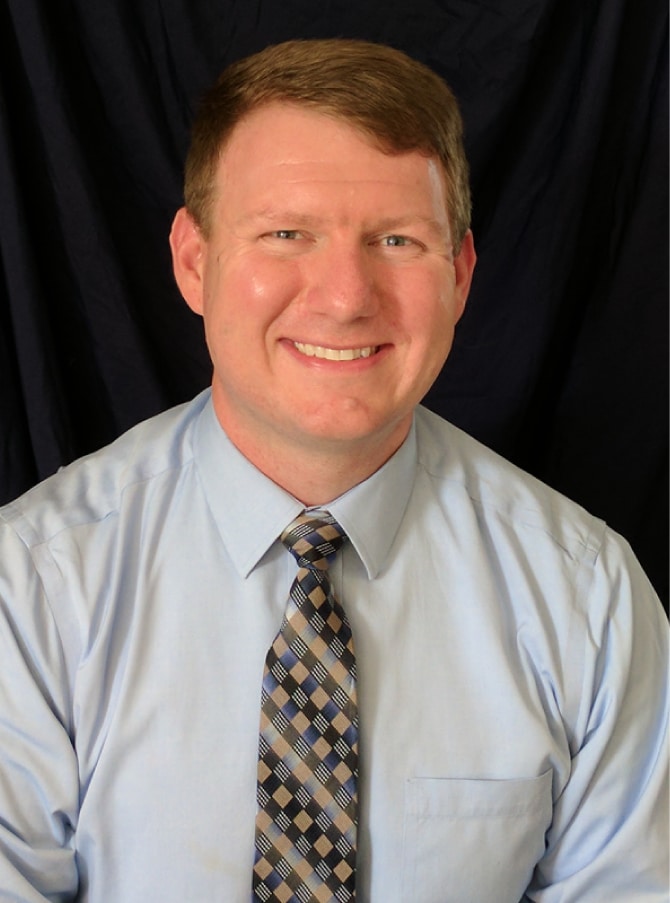
Dr. Matthew Karres has years of clinical experience fitting specialty contact lenses at COVE: scleral, RGP, multifocal, and orthokeratology designs for eyes other providers have given up on.
What that means in practice:
-
i.Topography-driven fitting from the first appointment. Every hard-to-fit case at COVE starts on the Oculus Keratograph 5M. We don't pick a lens from a catalog and see if it sticks.
-
ii.Two scleral lens platforms in-house. Zenlens® (diagnostic-trial workflow) and WAVE ScleraLens® (built directly from corneal topography) give us flexibility most practices don't have. When one platform isn't the right fit for a specific cornea, we have a genuine alternative.
-
iii.A fitting process that doesn't clock out. Revisions are included in the fitting fee until the lens is right. We don't send difficult cases home with "try to adapt to it."
-
iv.We see patients referred by other providers. Patients come to us from New Albany, Gahanna, Westerville, Johnstown, and across Central Ohio, often referred by other ODs who've reached the limit of their specialty lens capability.
Two scleral lens platforms in-house
Zenlens® and WAVE ScleraLens®, so one cornea isn't forced onto one system.
All revisions in one fitting fee
You don't pay per iteration, however long the fit takes to land.
Topography-driven fitting
Every hard-to-fit case starts on the Oculus Keratograph 5M.
If you've been told "we can't fit you," that's worth a second opinion. Many patients who have been told no still have options once we map the eye.
There's often a lens design that fits. Finding it takes the right tools, the right platforms, and the patience to work through the fitting process. That's the job. We don't stop when it gets complicated.
Patients who had given up on comfortable contacts are part of our 1,100+ five-star Google reviews. Reviewers with hard-to-fit prescriptions describe doctors who stay with the fit until it’s right, and appointments that don’t feel rushed.
“a next level experience” · “very thorough and patient on everything” · “I don’t trust anyone else with my eyes”
Read the reviews for yourself on Google →Frequently asked questions.
Q.01 Can every "hard-to-fit" patient actually be fit in contacts? +
Q.02 Do I need a referral to see COVE for a specialty fit? +
Q.03 What's the difference between a specialty exam and a regular contact lens exam? +
Q.04 Will my insurance cover a specialty contact lens fit? +
Q.05 What if I've already tried scleral lenses somewhere else and they didn't work? +
Schedule a hard-to-fit contact lens consultation.
If you've tried contacts and been told they won't work for you, or if you've been wearing something uncomfortable for years because it's "good enough," a specialty consult is worth an hour of your time. We can usually tell you within the first appointment whether we can get you into a lens that actually works. We see patients from New Albany, Gahanna, Westerville, Johnstown, and across Central Ohio.
Related reading: Specialty contact lenses at COVE → · Scleral contact lenses → · Scleral lenses for keratoconus → · Contact lens exams at COVE → · Six signs your contacts never feel right →