Ortho-K vs LASIK: a non-surgical way to wake up and see.
You're tired of glasses, done with daytime contacts, and someone keeps telling you to just get LASIK. Fair enough. But there's a second way to wake up and see: orthokeratology (ortho-k), a custom lens that reshapes your cornea while you sleep. No laser, no incision, nothing permanent.
Both can give you clear daytime vision with nothing on your face and nothing in your eyes. The difference: LASIK is surgery you can't undo, and ortho-k is a lens you can simply stop wearing, which makes it worth evaluating for many people who aren't LASIK candidates, including kids.
How each one works.
LASIK
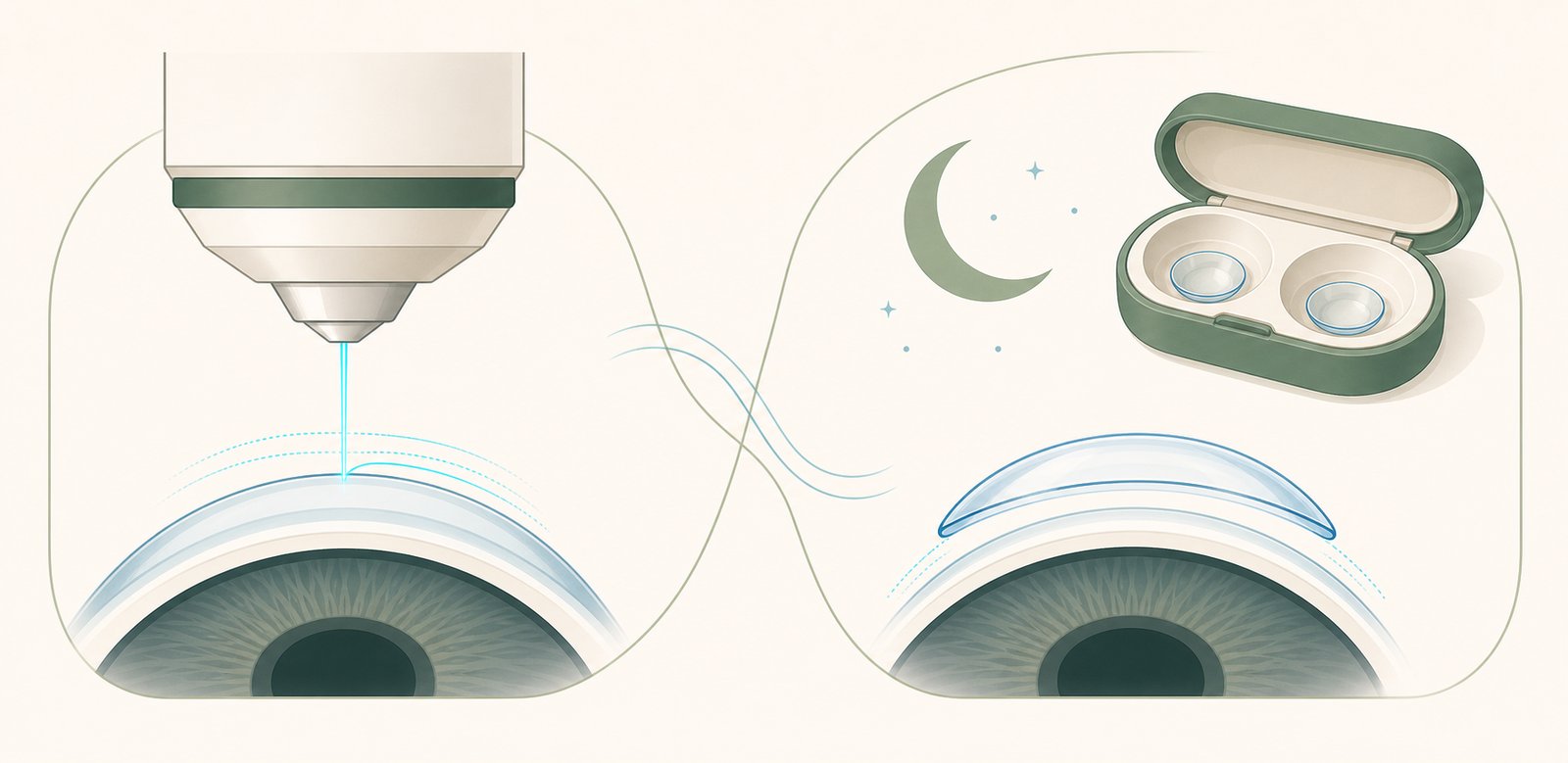
LASIK uses a laser to permanently change the shape of the cornea. It's a one-time surgical procedure, and for a good adult candidate it works well.
Ortho-K
Ortho-K uses a precisely shaped rigid lens (most often a WAVE NightLens, though we also fit Paragon CRT and Euclid Emerald designs) worn overnight. While you sleep it gently flattens the central cornea; you take the lenses out in the morning and see clearly through the day. The effect wears off gradually, so you wear the lenses each night to maintain it. Stop wearing them and your cornea returns to its original shape within days. Nothing is cut, and nothing is permanent.
Side by side.
Six places where the two approaches genuinely differ, including the ones where LASIK wins.
Neither wins outright. The honest answer depends on whose eyes we're talking about, and on how you feel about surgery.
When ortho-k is the better fit.
A few situations come up again and again in the exam chair.
When LASIK might be the better fit.
Sometimes the honest answer is surgery.
We don't perform LASIK, and we'll tell you honestly if we think surgery is the better path for you. If it is, we'll help you understand what to ask. If ortho-k is the better fit, that's something we do every week.
How to find out which is right for you.
The only way to know is an evaluation. We map your cornea on a topographer, check your prescription and eye health, and tell you plainly whether you're a good candidate and what results are realistic, or whether surgery deserves a closer look. Dr. Karres has spent years fitting ortho-k lenses at COVE, and patients travel here from across Central Ohio for specialty lens care.
The evaluation and the candidacy scans are at no charge, whether they happen during an eye exam or in their own appointment. One caveat: if it's been roughly six months or more since your last eye exam, we may need a current exam first (a normal billed visit) so we know where your eyes are starting from.
We'll point you toward whichever one is actually right for your eyes, even if that means LASIK.
The evaluation and candidacy scans are at no charge. If we think surgery is the better path for you, we'll say so plainly and help you understand what to ask, instead of just steering you toward what we do.
Common questions.
Q.01 Is ortho-k as effective as LASIK? +
For the right candidate, ortho-k can deliver clear daytime vision comparable to what people seek from LASIK, without surgery. You keep that result by wearing the lenses each night.
Q.02 Is ortho-k safe? +
Overnight ortho-k has been used for decades, and the gas-permeable materials worn while you sleep are FDA-approved for overnight wear. The lenses themselves are custom-designed to the shape of your own corneas rather than a stock, one-size-fits-all product, so your doctor maps your eyes, designs the fit, and checks it with a wear-and-care plan and scheduled follow-ups. As with any contact lens, hygiene and follow-up are what keep it safe.
Q.03 Can my child get LASIK instead? +
No. LASIK is for adults with a stable prescription. Ortho-k is one of the few options that works for children, and it may also help slow myopia progression.
Q.04 What if I try ortho-k and don't like it? +
You stop wearing the lenses and your corneas return to their original shape within days. That reversibility is one of ortho-k's biggest advantages over surgery.
Q.05 Does insurance cover ortho-k? +
Ortho-k is an elective service, and if you have VSP or EyeMed, your benefits may lower that cost. We review the full cost and what's included at the evaluation. See our ortho-k cost page.
Curious whether ortho-k could work for you?
The evaluation and candidacy scans are at no charge, and you'll get a straight answer about ortho-k, with an honest opinion if surgery is the better route. If your last exam was more than about six months ago, a current exam (a regular billed visit) may come first so we know where your eyes are starting from.