Scleral contact lenses, in New Albany, Ohio.
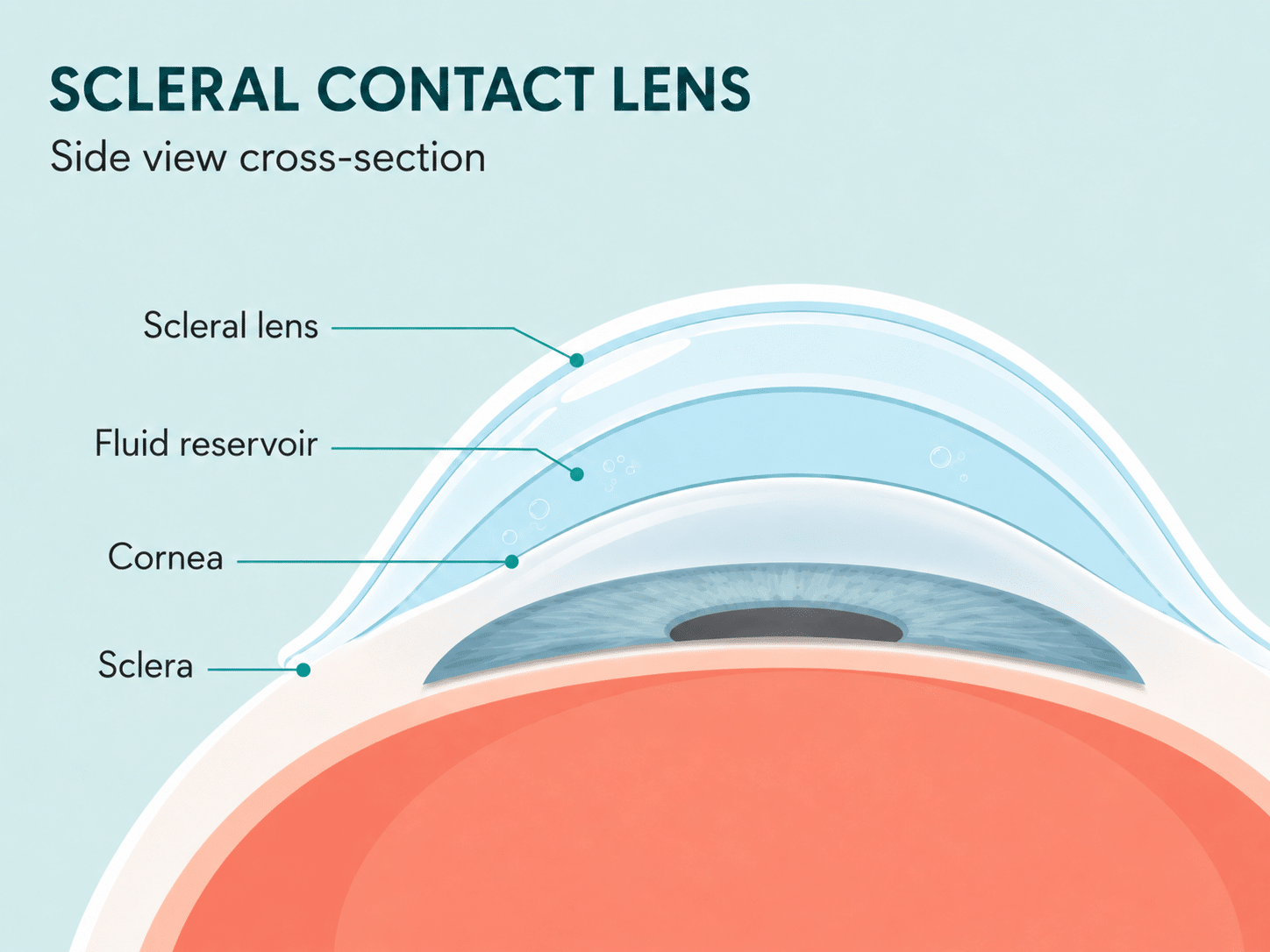
If another office told you your eyes are too complicated for contacts, that usually means the lens catalog ran out, not that your eye did. Scleral contact lenses are large-diameter, gas-permeable lenses that vault entirely over the cornea and rest on the white of the eye. The space between the lens and your cornea is filled with preservative-free saline. It's a continuous fluid reservoir that protects, hydrates, and creates a smooth, even optical surface.
For the right patient, sclerals do something no other lens can: they make a damaged, irregular, or extremely dry cornea behave optically like a healthy one. Keratoconus, severe dry eye, post-surgical complications, very high prescriptions, and the demand for the sharpest possible vision are the five most common reasons patients come to us for scleral lenses.
- I.What scleral lenses actually are01
- II.Who scleral lenses are for02
- III.How a scleral lens is fit03
- IV.What it actually feels like04
- V.What it costs and insurance coverage05
- VI.Why patients choose COVE06
- VII.Getting here from Columbus07
- VIII.What a consultation looks like08
- IX.Frequently asked questions09
What scleral lenses actually are.
A scleral lens is a rigid, gas-permeable contact roughly the size of a quarter, much larger than a soft contact, much larger than a traditional rigid (RGP) lens. It's designed to vault the cornea, meaning it is designed to vault clear of the corneal surface rather than rest on it. The corneal sensitivity that makes RGPs uncomfortable for so many patients is bypassed entirely.
Before insertion, you fill the bowl of the lens with preservative-free saline. The lens lands on the white of the eye (the sclera) and the saline stays trapped between the back of the lens and the front of your cornea all day. That fluid layer does three things at once: it bathes a dry or damaged cornea, it neutralizes corneal irregularities by creating a new optical surface, and it makes the lens itself feel almost like nothing is in your eye.
Most patients describe scleral lens comfort as better than soft contacts after a long day of wear. That surprises people. They expect a "hard" lens to feel hard. It doesn't.
See how a scleral lens works.
Press play for an interactive, chapter-by-chapter look at why an irregular cornea scatters light — and how a scleral lens floats above it on a cushion of fluid to bring back one sharp focus.
Who scleral lenses are for.
Sclerals aren't a first-line contact lens. They're the answer when soft contacts and traditional RGPs can't deliver. Either because the cornea isn't shaped normally, because the eye is too dry, or because the prescription demands more precision than a stock lens can give.
Keratoconus
Progressive corneal thinning that tilts vision into a smear no glasses or soft lens can fix. Sclerals vault the cone entirely and often restore functional, much sharper vision.
Severe dry eye
Sjögren's, GVHD, post-LASIK dry eye, ocular surface disease that has not responded to drops, plugs, or prescription therapy. The saline reservoir is a continuous bath for the cornea.
Irregular corneas
Post-LASIK ectasia, RK, post-transplant, scarring from injury or chemical burn. The lens replaces the irregular front surface with a smooth optical one.
The sharpest vision
Pilots, surgeons, photographers, marksmen, anyone who needs edge-case acuity. Sclerals can correct higher-order aberrations soft lenses simply cannot reach.
High prescriptions
Prescriptions stronger than off-the-shelf soft contacts can manage, especially extreme nearsightedness. Custom sclerals can be made in powers other lens designs can't reach.
How a scleral lens is fit.
Off-the-shelf scleral lenses do not exist for the patients who need them most. Every fit at COVE is a custom design, built around the specific shape of your eye.
-
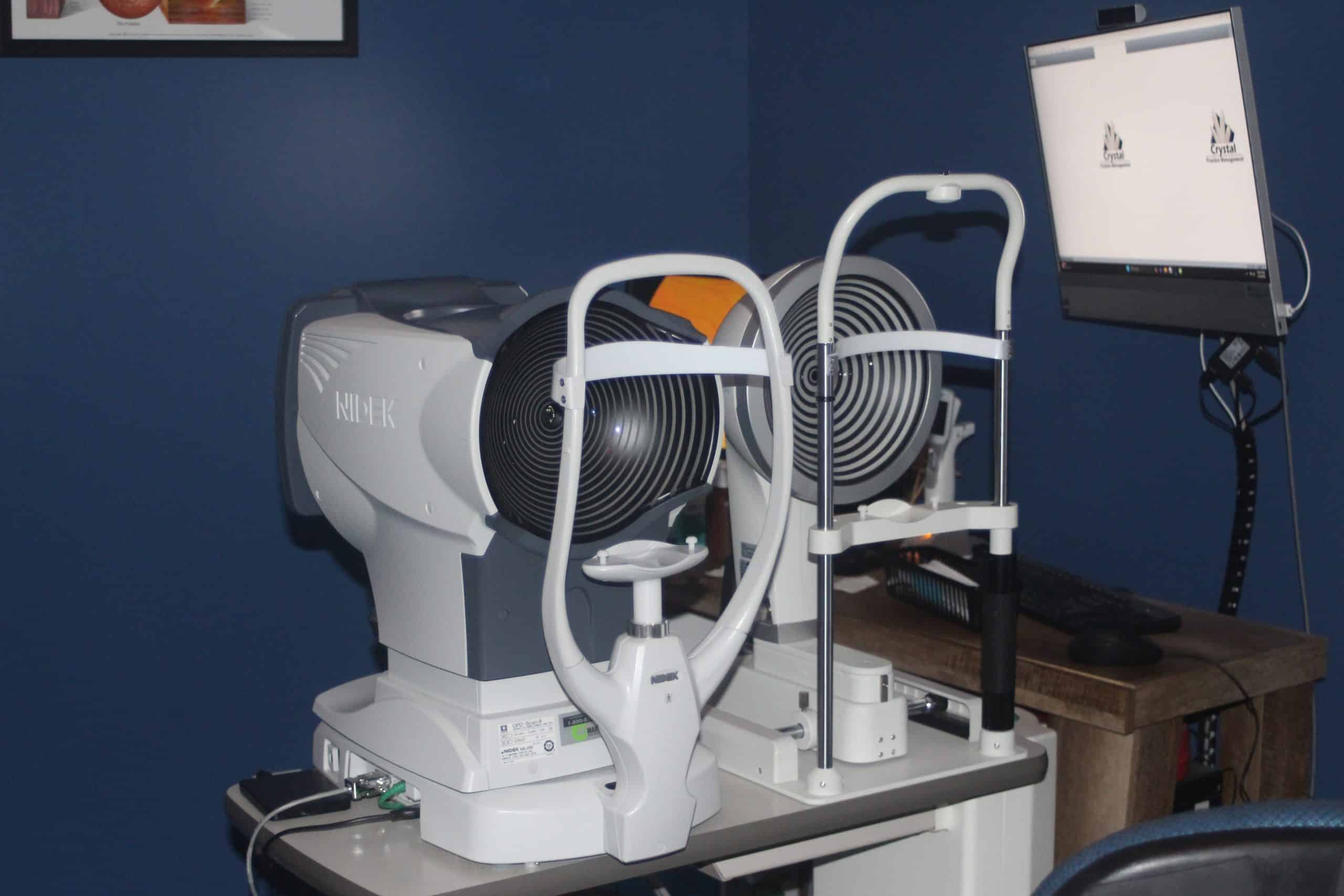
01Corneal topography on the Oculus Keratograph 5M. A precise map of your corneal curvature, elevation, and irregularities, down to the micron. This is the foundation of the lens design.
-
02Anterior segment OCT. Cross-sectional imaging that lets us see exactly how a lens will sit on your eye and where the saline reservoir lands.
-
03Lens platform selection: Zenlens® or WAVE ScleraLens®. Most of our fits use one of these two. They work very differently: Zenlens uses a diagnostic-trial workflow (a trial lens on the eye, evaluated and refined before the order), while WAVE ScleraLens is designed in CAD/CAM software directly from your topography map and manufactured to that exact design, with no diagnostic lens required. WAVE has been doing this since 1999. Having both in-house lets us pick the right tool for your eye, not the only tool we happen to carry.
-
04Custom lens design. The lab manufactures to our specifications.
-
05Dispense and refinement. A typical scleral fit takes 2–4 lens iterations to land on the final design. Some are right the first time. Some take longer. We don't stop until the fit is right.
What it actually feels like.
People imagine a quarter-sized rigid lens will be uncomfortable. The opposite is usually true, once the fit is dialed in.
First insertion
The first insertion is the hardest part. You're using a small plunger or scleral ring, you're tilting your head, you're holding a lens full of saline. We spend as much time as you need teaching this. Once the lens is on, most patients feel almost nothing. A brief awareness fades within minutes.
Settling in
Insertion gets faster. Most patients report comfort that holds through 8–12 hours of wear without midday discomfort. If you've struggled with traditional contacts dry-eye-wise, this is usually the moment you realize sclerals are different.
Forgetting the lens
Insertion takes seconds. Vision is stable from morning to night. You forget the lens is there. We see you back at the one-week, one-month, three-month, and six-month marks to confirm everything is sitting where it should.
What scleral lenses cost at COVE.
Scleral lens pricing depends on whether your fit is medically indicated or elective. For a full breakdown, see our guide to scleral lens cost and insurance coverage.
Medical-necessity fits
Keratoconus, severe dry eye, post-surgical eyes, irregular corneas. Most major vision plans (VSP, EyeMed) include a Medically Necessary Contact Lens benefit that applies to these fits. When it does, your out-of-pocket is significantly reduced. We verify this all the time.
Paying without insurance
For patients without a vision plan, with an exhausted benefit, or choosing an elective fit. One flat price covers the exam workup, the fitting with all doctor-directed revisions, and your first-year lenses.
- If you have VSP or EyeMed, your out-of-pocket may be significantly less than the full cost for a medically necessary fit. Most VSP and EyeMed plans include a Medically Necessary Contact Lens benefit that covers the bulk of the fitting and the lenses for diagnoses like keratoconus, severe dry eye, post-surgical complications, and other irregular-cornea conditions. Call us with your insurance card; we'll verify what we can in advance and confirm your qualification with you at the consultation.
- All scleral lens costs are FSA and HSA eligible.
- A typical scleral fit takes 2–4 lens iterations to dial in. The fitting fee covers all of those revisions; you do not pay per iteration.
Why patients come to COVE for scleral lenses.
Dr. Matthew Karres has years of clinical experience designing and fitting specialty contact lenses at COVE: scleral, gas-permeable, multifocal, and orthokeratology fits. His research interests within specialty contacts are focused on scleral lens solutions. Scleral lenses are not a side service at COVE. They're a focus.
Three things specifically separate a COVE scleral fit from a generic one:

-
i.Topography-driven, custom design from day one. Every fit starts on the Oculus Keratograph 5M and is informed by anterior segment OCT imaging. We don't fit empirically off a paper Rx; we fit off your actual corneal map.
-
ii.Two trusted lens platforms. Most fits use Zenlens® or WAVE ScleraLens®. We've fit many cases on both and know which platform suits which presentation.
-
iii.We don't pass off the hard cases. Newly diagnosed keratoconus, post-LASIK ectasia, severe surface disease: these are the fits we're known for. When they're hard, we keep working until the lens is right.
Sclerals are custom lenses. Even with topography and OCT and a careful diagnostic trial, the first lens isn't always the final lens. We design every case shooting for great vision and comfort on the first try. When we miss, we keep iterating, at no extra fitting fee, until we land it.
What we ask of you: come to your follow-ups, wear the lenses as we prescribe them, and tell us specifically what's bothering you when something feels off. The patients who get the best results are the ones who stay engaged with the process.
Scleral lenses for Columbus and Central Ohio.
We're in New Albany, on the northeast side of the Columbus metro, about 20 minutes from downtown Columbus on average and a shorter drive from Gahanna, Westerville, Johnstown, Blacklick, and Pataskala. You don't have to drive into the city center to find a practice that does this work in depth.
Distance is worth thinking about with sclerals, because the fit isn't one appointment. It starts with a corneal topography scan. Your lens is designed from that map, then you come back for a dispense visit where we teach you to insert it, and we see you again at one week, one month, three months, and six months to confirm the lens is sitting where it should. If the design needs to change along the way, every doctor-directed revision during the fitting period is included rather than billed per attempt.
Some patients travel two hours or more each way to have their sclerals fit here. That doesn't mean you should. It means the fitting details matter enough that some people decide the drive is worth it. What they're driving to is a lens designed from their own corneal map on one of two scleral platforms we keep in-house, rather than one picked out of a catalog.
What a scleral lens consultation looks like.
You can do most of a scleral consultation as part of your annual eye exam. No separate visit required. The full process typically runs:
-
Step 1Routine eye exam plus corneal topography and anterior segment OCT. We confirm scleral lenses are the right answer for your eyes and gather the imaging needed to design the fit.
-
Step 2Lens platform decision and design. Whether you fit best on Zenlens® or WAVE ScleraLens® depends on your cornea. We pick the platform, then either trial a diagnostic lens (Zenlens) or design the lens directly from your topography (WAVE).
-
Step 3Lens design ordered. Typically 1–2 weeks from order to lens-in-hand.
-
Step 4Dispense visit. We teach insertion, removal, and care. You wear the lens home that day.
-
Step 5Follow-ups at 1 week, 1 month, 3 months, and 6 months. Refinements happen at any of these visits as needed.
For newly diagnosed keratoconus, we often coordinate with corneal specialists for cross-linking, a procedure that helps stabilize a progressing cone. Sclerals manage the optical side; cross-linking manages the disease side. Both matter, and they work well together.
Patients who had given up on comfortable contacts are part of our 1,100+ five-star Google reviews. Reviewers with hard-to-fit prescriptions describe doctors who stay with the fit until it’s right, and appointments that don’t feel rushed.
“a next level experience” · “very thorough and patient on everything” · “I don’t trust anyone else with my eyes”
Read the reviews for yourself on Google →Frequently asked questions.
Q.01 How long does a scleral lens last? +
Q.02 Can I sleep in scleral lenses? +
Q.03 How do I clean a scleral lens? +
Q.04 Will insurance cover my scleral lenses? +
Q.05 What if my eyes change and the lenses stop fitting? +
Q.06 Are scleral lenses better than RGP lenses? +
Q.07 Can I drive home after a scleral fitting? +
Schedule a scleral lens consultation.
If glasses don't correct your vision well, if soft contacts hurt or don't sit right, or if you've been told your eyes are hard to fit, sclerals are likely the answer. The first step is a corneal topography scan and a conversation. We can do both at your next routine eye exam.
All three of our doctors fit scleral lenses. Dr. Karres designs them on the WAVE platform, shaping each lens to the eye in front of him.
A scleral fit is a contact lens fitting, so it books as a contact lens exam. That gives us the time to measure the eye and decide what the lens has to do.
Have you been seen at COVE before?
Bring your glasses and any lenses you wear now, and we will go through your options at the visit. Prefer a person? Call (614) 933-0575 during office hours.