Binocular vision dysfunction care in New Albany, Ohio.
It's the headache that arrives at the same point in every workday. The sentence you just reread because the line drifted. The nagging sense that your glasses are right but something is still off. Most eye exams check how clearly each eye sees on its own; they don't always check how well the two eyes work together, and you can read 20/20 on the chart while that teamwork quietly fails. Symptoms like these are sometimes traced to binocular vision dysfunction.
At COVE we test for it directly, and when we find it, we treat it with two tools that have a long clinical track record: prescription prism in your glasses and a structured set of home-based vision therapy exercises. Both work toward the same goal, which is easing the strain of keeping your two eyes working together.
What binocular vision dysfunction actually is.
Your brain builds a single, stable image by fusing the slightly different views from your two eyes. That fusion takes constant muscular effort to keep the eyes aimed at the same point. When the eyes are even slightly misaligned, your visual system has to work harder than it should to force them together. For a while it manages. Over a day, over a screen-heavy job, over a school year, that effort can run out, and that's often when symptoms show up.
This is different from needing a stronger glasses prescription. You can have perfect distance vision and still have a binocular problem, because the issue isn't sharpness in one eye, it's coordination between the two.
Conditions that fall under this umbrella include convergence insufficiency (the eyes struggle to turn inward for close work), accommodative dysfunction (the focusing system fatigues), and vertical and horizontal misalignments (heterophoria). Binocular or focusing problems can also contribute to some of the visual symptoms that linger after a concussion.
Signs your eyes may not be working together.
Many of these get blamed on screens, stress, or "just needing reading glasses." Sometimes that's the answer. Sometimes a binocular vision problem is contributing, and a coordination-focused exam can find it.
In kids, the symptoms often look like a reading or attention problem rather than an eye problem, which is part of why binocular vision dysfunction gets missed.
How we test for it.
A coordination problem doesn't show up on the standard "read the smallest line you can" test. Finding it takes a different set of measurements.
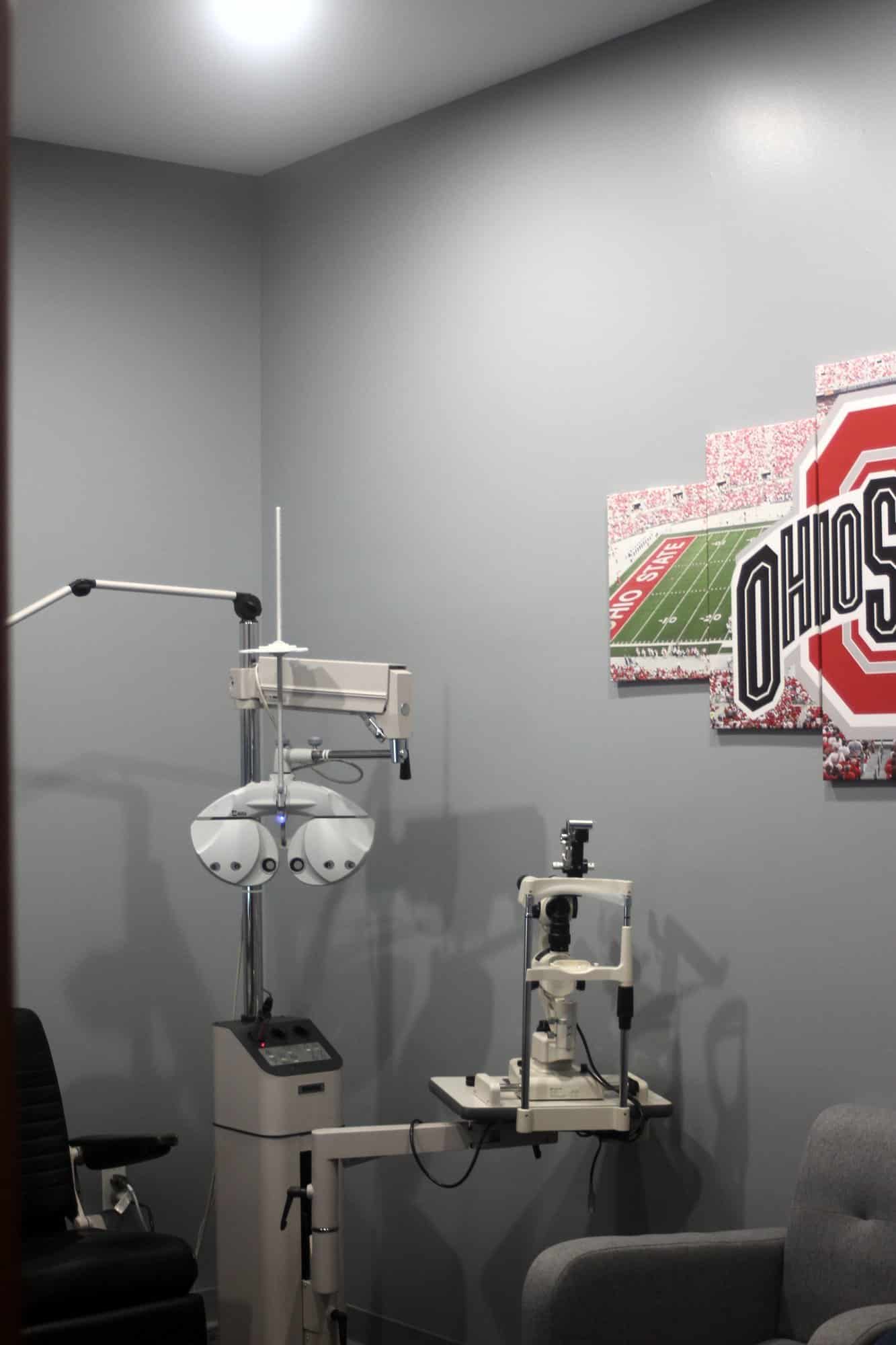
At your exam we measure how your eyes align at distance and near, how well and how comfortably they converge for close work (including how close a target can get before your eyes lose it), how your focusing system responds and recovers, and how stable your fusion is under load. We also rule out the things that can imitate these symptoms, including an out-of-date prescription, dry eye, and general eye health issues, using the same exam technology we use for every patient (the iCare tonometer for pressure, with no drops or air puff, and wide-field retinal imaging).
The point of the workup is a straight answer: is this a binocular vision problem, and if so, which kind, and how significant. From there we can talk treatment.
Prism lenses: realigning the image.
Prism is a built-in correction that bends light before it reaches your eye, shifting the image to where your eyes are already comfortably aimed. Instead of your visual system straining to pull the two images together, the lenses do part of that work, so the two eyes land on a single fused image with less effort.
For many people with a measurable alignment problem, prism in their everyday glasses can ease the strain, headaches, and doubling. We measure the amount of prism carefully and can refine it over follow-up visits as your system adapts. Prism is prescribed by the doctor and ground into your glasses lenses, and our in-house lens lab does that finishing work.
Prism is often the right first step for vertical and horizontal misalignments. For convergence and focusing problems, prism and vision therapy are frequently used together.
Home-based vision therapy: training the system.
Vision therapy is a structured program of exercises designed to retrain how your eyes coordinate, converge, and focus together. For conditions like convergence insufficiency, targeted exercises can help some patients improve how the two eyes work together. Results vary from person to person, and the most intensive cases are usually better served by an in-office therapy program.
COVE's vision therapy program is home-based. After we diagnose the problem and set the plan, you (or your child, with a parent's help) work through a defined set of exercises at home on a regular schedule, and we check progress at follow-up visits and adjust the program as you improve. To be clear about the model: this is a guided home program with in-office check-ins, not a daily in-office therapy clinic with a dedicated therapist. And the honest tradeoff of any home program is that it only helps if you actually do the exercises. We make the plan specific and the follow-ups regular, but the day-to-day consistency is yours to bring. For many convergence and focusing problems, a well-run home program can be an effective and far more practical path.
If your case is severe or complex enough to need intensive in-office therapy that's beyond what a home program can do, we'll tell you, and we'll help you find the right provider for that level of care.
If you read 20/20 and still fight eye strain, headaches, or double vision, the problem may be how your two eyes work together.
We see patients from New Albany, Gahanna, Westerville, Johnstown, and across Central Ohio. Prism and home-based vision therapy are two well-established options we may consider, depending on what the evaluation finds.
Visual symptoms after a concussion.
Many of the symptoms that linger after a concussion can be visual. After a head injury, the systems that keep your eyes aligned and focused can be disrupted, which may leave you with eye strain, difficulty reading, double or unstable vision, and a worse-than-usual reaction to busy, moving, or screen-heavy environments.
These symptoms are real and worth evaluating. A binocular vision workup can identify the specific alignment and focusing changes that may be contributing, and prism or home-based vision therapy may be options depending on what we find. If you're working with a concussion or rehab team, we're glad to coordinate as part of that care.
Who this is for, and what the first visit looks like.
This evaluation is worth booking if you have ongoing eye strain or headaches with near work, if you see double or notice words moving on the page, if reading is harder than it should be, if you have lingering visual symptoms after a concussion, or if your child shows the reading-avoidance pattern above.
The first visit is a focused binocular vision evaluation. We take a careful history, run the alignment and focusing measurements, rule out the look-alike causes, and give you a clear read on whether this is a binocular problem and what we'd recommend. If prism is the answer, we can often start there. If a vision therapy program makes sense, we'll lay out the plan and the follow-up schedule. You leave knowing what's going on and what the path looks like.
A binocular vision evaluation is part of an eye exam, and some testing and treatment may be billable. Coverage rules vary by plan, so bring your insurance card and we'll verify what we can in advance and confirm the coverage details with you. We accept VSP and EyeMed vision plans, and we can talk through medical coverage and COVE Plus if you don't have vision insurance.
Common questions.
Q.01 Can I have 20/20 vision and still have binocular vision dysfunction? +
Yes. The eye chart measures how clearly each eye sees on its own. Binocular vision dysfunction is about how the two eyes work together, which is a separate function. You can read 20/20 and still have eye strain, headaches, or double vision that a coordination problem is contributing to.
Q.02 Is COVE's vision therapy done in the office or at home? +
Our vision therapy is a home-based program. We diagnose the problem, set up the exercise plan, and monitor your progress at follow-up visits, while you do the exercises at home on a regular schedule. For cases that need intensive in-office therapy, we'll refer you to a provider who offers that.
Q.03 Can binocular vision dysfunction be treated in kids? +
Yes. In children the symptoms frequently look like a reading or attention problem, so a coordination-focused exam is the key to catching it. Some children do well with prism, a home vision therapy program, or both; what we recommend depends on what the exam finds.
Q.04 How long does treatment take? +
It depends on the condition and its severity. Some people feel relief from prism quickly. A vision therapy program for something like convergence insufficiency typically runs over a series of weeks with regular practice. We set expectations at the evaluation and track progress at follow-ups.
Q.05 Will my insurance cover this? +
A binocular vision evaluation is part of an eye exam, and some testing and treatment may be billable. Coverage rules vary by plan, so bring your insurance card and we'll verify what we can in advance and confirm the coverage details with you. We accept VSP and EyeMed vision plans, and we can talk through medical coverage and COVE Plus if you don't have vision insurance.
Get evaluated for binocular vision dysfunction.
If reading, screens, or daily life come with eye strain, headaches, or double vision, a focused binocular vision evaluation can tell you why. Call us or book online.