
Scleral lenses for keratoconus, in New Albany, Ohio.
Keratoconus is a progressive condition that thins and changes the shape of your cornea, the clear front surface of your eye. As the cornea becomes steeper and more cone-shaped, glasses may no longer provide clear vision. A scleral contact lens is a large, rigid lens that vaults over the cornea. A reservoir of preservative-free saline fills the space beneath it, and together they create a smooth optical surface that often provides sharper, more functional vision.
At COVE, every keratoconus fit begins with corneal topography, a detailed map of your cornea. We use that map and other imaging to design your fit with Zenlens® or WAVE ScleraLens®. The platform we select depends on your corneal shape and your fitting needs.
Scleral lenses may improve your vision while you wear them. They do not treat keratoconus or slow its progression.
- What keratoconus does to vision01
- Why scleral lenses work for keratoconus02
- When scleral lenses may help03
- How the fitting process works04
- Why COVE uses two lens platforms05
- Cross-linking and your complete care plan06
- Wearing and handling scleral lenses07
- Cost and vision-plan coverage08
- Keratoconus care at COVE09
- Frequently asked questions10
What keratoconus does to vision.
Keratoconus causes the cornea, the clear front window of the eye, to become thinner and bulge outward in a cone. It is progressive, which means the shape may continue changing over time. The irregular surface bends light unevenly and can prevent glasses from providing clear vision.
Early signs may include increasing blur, duplicate or ghost images, streaks around lights at night, and frequent prescription changes. Standard soft contact lenses may also feel unstable or uncomfortable as the cornea becomes more irregular.
Keratoconus is not your fault. It can run in families, often appears during adolescence or early adulthood, and changes at a rate that varies from person to person. Your care plan has two goals. Corneal cross-linking, performed by a corneal specialist, may help slow or halt progression by strengthening the cornea. Scleral lenses address the vision changes by creating a smoother optical surface.
Why scleral lenses work for keratoconus.
A scleral lens is a large, rigid, gas-permeable contact lens. Gas-permeable means oxygen can pass through the lens material. The lens vaults over your cornea and rests on the sclera, the white part of your eye. Preservative-free saline fills the space between the lens and the cornea.
This design addresses three common challenges caused by keratoconus:
The optical problem
Keratoconus creates an irregular corneal surface that scatters incoming light. A scleral lens and its saline reservoir create a smooth optical surface over that irregular shape, so light can focus more clearly on the retina, the light-sensitive tissue at the back of your eye. Many patients gain meaningfully sharper vision than glasses can provide.
The comfort problem
Traditional rigid gas-permeable lenses, often called RGP lenses, rest directly on the cornea, and their movement across an irregular surface may cause discomfort. Scleral lenses are designed to vault over the cornea and rest on the white of the eye. Many patients find this design more comfortable than a smaller corneal lens.
The stability problem
Soft lenses and RGP lenses can move with each blink, and movement over a cone-shaped cornea may cause vision to change throughout the day. Scleral lenses are larger and designed to remain seated on the eye, which often provides steadier vision.
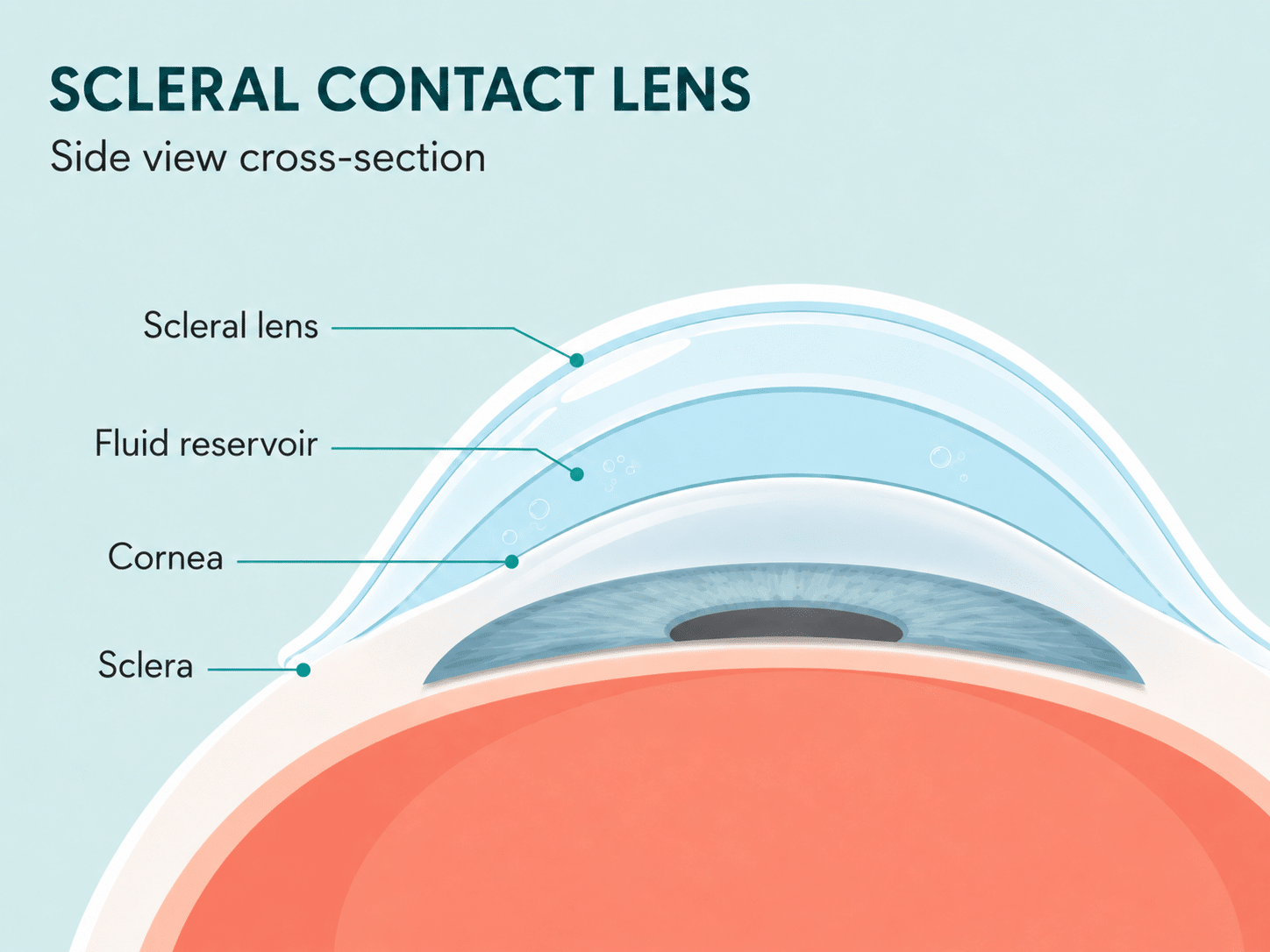
See how a scleral lens works.
Press play to see how a cornea can become steeper and more cone-shaped. The animation also shows why glasses may stop providing clear correction, and how a scleral lens creates a smoother optical surface.
When scleral lenses may help.
Lens choice depends on the shape of your cornea, your vision, and your comfort. Some early-stage cases do well for years in soft toric lenses, which correct astigmatism, or hybrid lenses, which combine a rigid center with a soft outer edge. Scleral lenses are often the next step when one or more of the following applies:
Glasses no longer correct your vision
If your best-corrected vision in glasses is worse than 20/40 (and especially if it's worse than 20/60), your cornea is irregular enough that you've crossed past what spectacle lenses can fix.
RGP lenses hurt or will not stay centered
A smaller RGP lens may feel uncomfortable or move away from the center of a cone-shaped cornea. Either problem can make the lens difficult to wear. A scleral lens uses a wider landing area on the white of the eye, a design that may improve comfort and help the lens remain centered.
Soft contacts give you blurry or unstable vision
A soft lens follows the shape of the cornea. It may provide some improvement while leaving ghost images, streaks, or vision that changes through the day. A scleral lens creates a new optical surface over the cornea, which may provide sharper and more stable vision.
You've been told you're "hard to fit"
Complex fitting needs can include advanced cones or very steep keratometry readings, also called K readings, which describe the curve of your cornea. Other complex cases include corneas that have undergone cross-linking, or corneal hydrops, a sudden corneal swelling caused by fluid entering the cornea. Custom scleral lenses let us adjust the vault, diameter, and landing area for these shapes, and your examination determines whether a scleral lens may help.
How a scleral fit for keratoconus works.
Every keratoconus lens is custom-designed around the shape of your eye. COVE uses two complementary lens platforms, and we select the platform after reviewing your corneal map and examining your eyes.
-
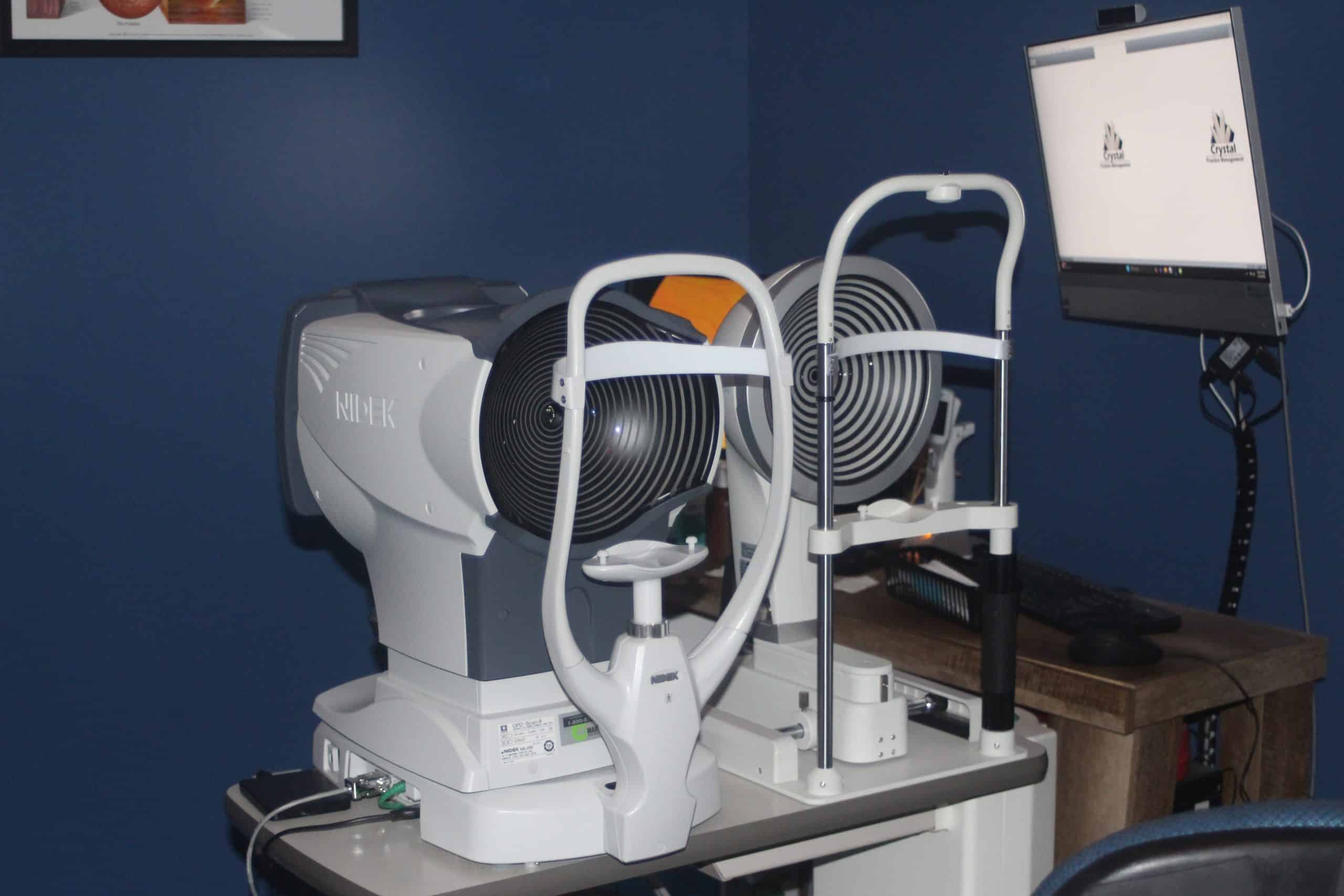
01Routine eye exam and corneal topography. The Oculus Keratograph 5M creates a detailed surface map of your cornea. Those measurements guide the lens design.
-
02Anterior segment OCT. Optical coherence tomography, or OCT, is a scan that shows a cross-sectional view of the front of your eye. It helps us evaluate lens clearance and the saline reservoir over the cone.
-
03Lens platform selection. We choose Zenlens®, which uses a diagnostic trial lens, or WAVE ScleraLens®, which begins with your corneal map (see below). Different corneal shapes may fit better with different design methods, and having both options helps in advanced or unusual cases.
-
04Custom lens design. We send the measurements and design specifications to the laboratory for manufacturing.
-
05Dispense and refinement. We aim to get the design right the first time. It is not unusual for a fit to take two to four lenses, and advanced cones sometimes take more. The fitting fee covers every revision, so you do not pay per iteration.
Why COVE uses Zenlens® and WAVE ScleraLens®.
COVE uses two scleral lens platforms with different design methods. Access to both lets us select a method based on your corneal shape and your fitting needs.
Zenlens®: diagnostic-trial workflow
We begin by placing a diagnostic Zenlens® on your eye and evaluating its vault over the cornea, its landing on the sclera, and the space around its edge. We then adjust the lens order using what we observed. This workflow works well for many keratoconus cases, especially earlier-stage cones with a relatively regular corneal map.
WAVE ScleraLens®: designed from your map
A WAVE ScleraLens® design begins directly with your corneal topography. Computer-aided design and manufacturing software uses that map to create a customized lens specification. WAVE has been doing topography-driven scleral design since 1999. This method can be useful for advanced or unusual cones when a diagnostic trial lens may not closely represent the final design.
Two scleral platforms at COVE
COVE fits both Zenlens® and WAVE ScleraLens®.
A fit guided by your corneal map
The Oculus Keratograph 5M creates the corneal map used to guide your fit.
Fitting revisions are included
Your fitting fee includes lens revisions during the fitting period. You do not pay a separate fitting fee for each iteration.
Cross-linking and your complete care plan.
For newly diagnosed or progressing keratoconus, we strongly recommend an evaluation for corneal cross-linking. This procedure uses riboflavin, a light-sensitive vitamin solution, and ultraviolet light to strengthen the cornea. Its goal is to slow or halt disease progression. A corneal specialist performs cross-linking, and COVE coordinates your referral and the timing of your scleral lens fit.
Cross-linking
Aims to slow or halt the progression of keratoconus. It does not serve as vision correction.
Scleral lenses
May restore functional vision while you wear them. They do not slow or halt keratoconus.
Many patients with progressing keratoconus have a plan that includes both forms of care. Cross-linking manages progression, while scleral lenses provide vision correction during wear. We talk through the sequencing during your consultation.
Wearing and handling scleral lenses.
Learning to insert a scleral lens takes practice. We teach you how to hold the lens, fill it with saline, and place it on your eye. Your experience changes as you become more familiar with the process.
Your first insertion
For many patients, the first insertion is the most challenging. You use a small plunger or scleral ring while holding a lens filled with saline. We spend the time you need on each step. Vision often clears within a minute after insertion, and many patients describe mild lens awareness that fades as they adjust.
Your first week
Insertion often becomes easier with practice. Some patients gradually build toward 8–12 hours of comfortable wear, following the schedule prescribed for them. Patients who previously found RGP lenses uncomfortable may notice a meaningful difference with the scleral design.
Your first month
With practice, insertion may take only seconds. Many patients experience stable vision throughout their approved wearing time. We set your follow-up visits around what your eyes need. Some patients want more check-ins while they settle in, and others are comfortable quickly. We keep seeing you until the fit sits where it should and the cone underneath is stable.
Cost and vision-plan coverage.
A keratoconus scleral fit may qualify as medically necessary, which means the lenses are needed to address vision that standard correction cannot adequately manage. Coverage for medically necessary specialty contact lenses is handled through your vision plan, and your final responsibility depends on your specific benefits.
Our scleral lens cost and insurance coverage page walks through the pricing scenarios, the medically necessary contact lens benefit, and how we verify your plan before your consultation.
Keratoconus scleral fitting
The fitting includes corneal topography, anterior segment OCT, lens design, the dispense visit, and the full follow-up schedule. Lens revisions during the fitting period are included. You do not pay a separate fitting fee for each iteration.
- VSP and EyeMed plans may include a Medically Necessary Contact Lens benefit for keratoconus. When the benefit applies, it may cover part of both the fitting and the lenses. Coverage and patient responsibility vary by plan. Call us with your insurance card, and we will confirm your qualification together at the consultation.
- Without an applicable vision benefit, our COVE Plus Sclerals program offers one flat self-pay price that includes the exam, the fitting, and the first year of lenses for both eyes. We verify what we can in advance and confirm together at the consultation.
- Scleral lens expenses are eligible for Health Savings Account (HSA) and Flexible Spending Account (FSA) funds.
- Specialty contact lenses are replaced annually. Changes in your prescription or corneal shape may affect the replacement design.
Keratoconus care at COVE.
Keratoconus is a central part of COVE's specialty lens work, and it is one of the main reasons COVE built around topography-driven scleral fitting. Dr. Matthew Karres has years of clinical experience fitting specialty contact lenses at COVE: scleral, gas-permeable, multifocal, and orthokeratology fits. Today he personally designs each patient's WAVE ScleraLens, which is clinical design work.
Dr. Karres also held a separate position as a research optometrist at The Ohio State University College of Optometry. That research studied contact lens solutions, scleral lens filling solution, and atropine.
What this means for your care:
-
i.Topography-driven custom design. Every keratoconus fit at COVE begins with an Oculus Keratograph 5M map and is informed by anterior segment OCT.
-
ii.Two established lens platforms. Zenlens® uses a diagnostic-trial workflow, and WAVE ScleraLens® begins with your corneal topography. Having both supports early cones, advanced cones, post-cross-linking corneas, and corneas with a history of hydrops.
-
iii.Experience with complex fits. Advanced cones and very steep K readings are part of COVE's specialty lens work, and we use custom measurements to guide each design.
-
iv.Coordinated cross-linking care. We refer patients to corneal specialists when an evaluation for cross-linking is appropriate, and we coordinate the lens fit with the procedure timeline so your vision is managed continuously.
Complex corneas take more design passes. Those revisions are part of the fitting fee.

Keratoconus fits can require several design changes. We aim for clear vision, healthy lens clearance, and comfortable wear. When refinement is needed, fitting-period revisions are included without an additional fitting fee.
You can help by coming to your follow-ups, wearing the lenses as we prescribe them, and describing any discomfort or vision change. Your feedback helps us refine the design and monitor your eyes.
COVE has more than 1,100 five-star Google reviews. Reviews from patients with hard-to-fit prescriptions describe careful fitting and unhurried appointments.
“a next level experience” · “very thorough and patient on everything”
Read COVE reviews on Google →Frequently asked questions.
Q.01 Will scleral lenses cure my keratoconus? +
Q.02 Can I wear scleral lenses if I've already had cross-linking? +
Q.03 What if my keratoconus is very advanced? +
Q.04 How long will my scleral lenses last? +
Q.05 Will my keratoconus keep getting worse? +
Q.06 Can I work, drive, and play sports in scleral lenses? +
Q.07 Will my insurance pay for this? +
Schedule a keratoconus consultation.
If you have keratoconus and your current correction is no longer working well, the first step is a corneal topography scan and a conversation. You can also start here if your eye doctor recently mentioned the diagnosis and you want to understand your options. We can complete both at your next routine eye exam, then review the results and discuss the next steps together.
Related reading: our scleral lens hub · sclerals for irregular and post-surgical corneas · scleral lenses for severe dry eye · scleral lenses for high prescriptions · hard-to-fit contacts in New Albany · specialty contact lens overview · living with keratoconus: what scleral lenses do