
Scleral lenses for irregular and post-surgical corneas, in New Albany, Ohio.
If surgery was supposed to simplify your vision and instead left you chasing clarity, you are not starting from zero here. When the front surface of the eye isn't shaped the way it used to be (because of LASIK that didn't go as planned, RK from decades ago, a corneal transplant, an injury, or a scar), glasses and standard contacts can't always give you back the vision you had. Scleral contact lenses can. They vault over the irregular surface and create a smoother optical surface in front of it.
Many patients who'd been told they were "uncorrectable," or who'd been living with ghost images, halos, and fluctuating vision for years, gain more functional, stable vision in their sclerals. At COVE, every fit is custom-designed off your specific corneal topography, with two lens platforms we know and trust: Zenlens® and WAVE ScleraLens®.
- When the cornea isn't shaped like it used to be01
- Why scleral lenses work for irregular corneas02
- Who this page is for03
- How the fit process works04
- Why two lens platforms05
- A note for transplant patients06
- What it actually feels like07
- What it costs and insurance coverage08
- Why patients come to COVE09
- Frequently asked questions10
When the cornea isn't shaped like it used to be.
The cornea is the clear front window of the eye. Its job is to be smooth and uniformly curved. That's how light gets focused cleanly onto the retina. When something disrupts that shape, vision degrades in ways that no glasses prescription can fully correct, no matter how strong.
The irregular corneas we see most often at COVE come from one of four sources:
- Refractive surgery that didn't deliver what was promised. LASIK ectasia, problematic PRK outcomes, the older RK procedure from the 1980s and 1990s.
- Corneal transplants. Penetrating keratoplasty (PK), deep anterior lamellar keratoplasty (DALK), endothelial transplants: all leave the cornea with edges, sutures, or asymmetric curvature that glasses can't accommodate.
- Trauma and scarring. Foreign body injuries, chemical burns, severe infections that left a scar, sports impact, surgical complications.
- Pellucid marginal degeneration and other irregular dystrophies. Less common than keratoconus but managed similarly.
The common thread is that the cornea no longer focuses light cleanly, and the patient is left with vision that fluctuates, ghosts, splits, or simply will not sharpen.
Scleral lenses are the most effective solution we have for this entire category of problems.
Why scleral lenses work for irregular corneas.
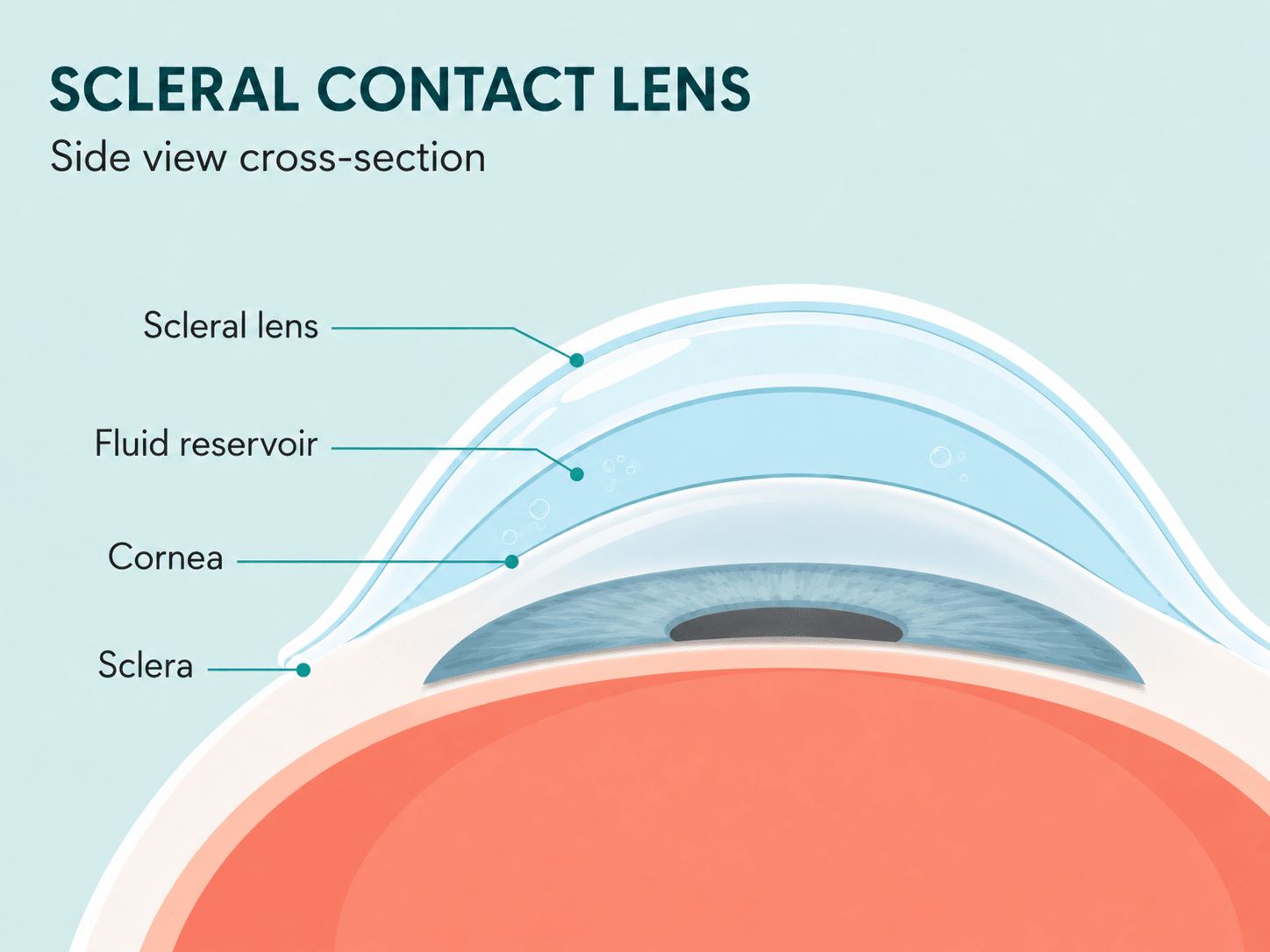
A scleral lens is a large, gas-permeable contact lens that vaults entirely over the cornea and rests on the white of the eye. The space between the lens and your cornea is filled with preservative-free saline. The lens is designed to vault the cornea rather than rest on its surface.
That design solves the irregular-cornea problem in three ways at once:
The optical problem
Light entering a scleral lens passes through a smooth front surface. The irregular cornea underneath is no longer the primary optical surface. The lens is. This is why patients with severe astigmatism, scarring, or distortion that glasses couldn't correct often gain meaningfully sharper vision in sclerals.
The contact problem
Traditional rigid (RGP) contact lenses sit directly on the cornea. On an irregular surface, especially a post-surgical one with sutures, edges, or scar tissue, that contact is uncomfortable, unstable, and risky. Sclerals vault the cornea entirely. There's no contact between lens and cornea.
The protection problem
A vulnerable cornea (post-transplant, post-trauma, scarred) benefits from being shielded from blinking friction and environmental irritation. The saline reservoir is also a continuous protective bath, which often improves comfort and surface health alongside the optical correction.
Who this page is for.
Post-LASIK ectasia or unhappy outcome
LASIK works well for the vast majority of patients. For a small subset, the cornea progressively thins after surgery (post-LASIK ectasia), or the visual quality never matches what was hoped for. Sclerals can restore vision in eyes that have become uncorrectable in glasses after surgery, and we coordinate cross-linking referrals when ectasia is progressing.
Post-RK (radial keratotomy)
RK was a popular surgery in the 1980s and 90s. Many patients did well for years, but the radial cuts can leave the cornea with diurnal fluctuation, glare, and progressive shifts decades later. Sclerals stabilize the optics and are often a major improvement for this group.
Post-corneal transplant (PK, DALK)
Transplants restore corneal clarity, but the new graft rarely sits at the same curvature as the surrounding tissue. Sutures, edge mismatch, and asymmetric astigmatism are common. Sclerals can help transplant patients reach more functional, stable vision once the graft has settled.
Corneal scarring or trauma
Old foreign-body injuries, chemical burns, severe infections, sports impact, surgical complications: anything that left a scar on the cornea. Sclerals replace the scarred surface optically and protect it from further mechanical irritation.
How a scleral fit for an irregular cornea works.
Off-the-shelf sclerals do not exist for irregular corneas. Every fit is a custom design built around your specific corneal shape. Irregular corneas often take more iterations to get right than healthy-eye fits. The fitting fee covers all of those iterations.
-
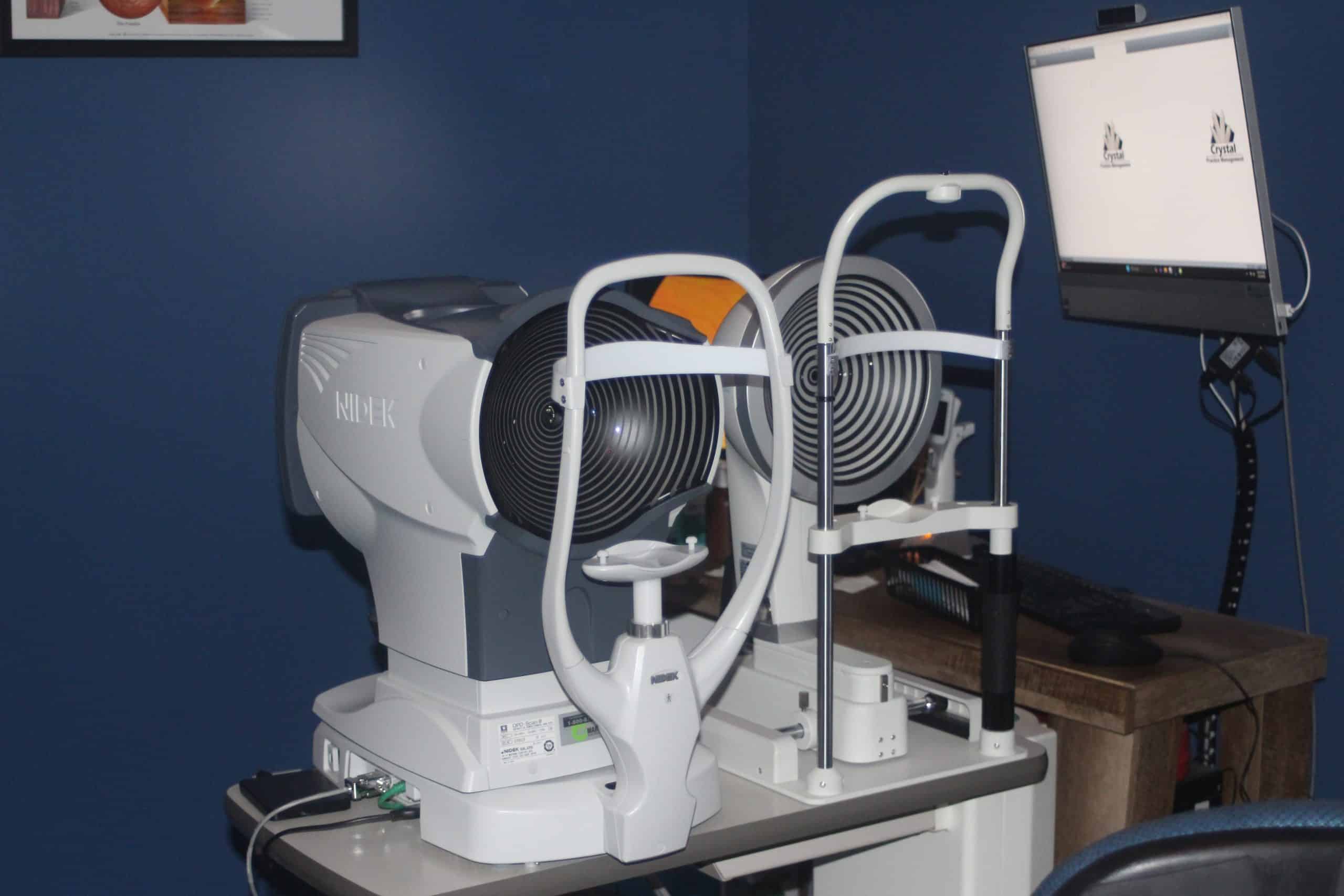
01Routine eye exam plus corneal topography. The Oculus Keratograph 5M maps the surface of your cornea down to the micron, including post-surgical edges, scar contours, and asymmetric curvature.
-
02Anterior segment OCT. Cross-sectional imaging that lets us see exactly how the lens will sit, where the saline reservoir lands, and how the lens edge interacts with the conjunctiva.
-
03Lens platform selection. Zenlens® (diagnostic-trial workflow) or WAVE ScleraLens® (built directly from your topography map). Irregular corneas often benefit from the WAVE workflow because a stock trial lens may not represent the post-surgical or scarred surface well.
-
04Custom lens design. The lab manufactures to our specifications.
-
05Dispense and refinement. Most irregular-cornea fits take 2–4 lens revisions to land on the final design, sometimes more for complex transplants or extensive scarring. The fitting fee covers all revisions; you do not pay per iteration.
Why two lens platforms: Zenlens® and WAVE ScleraLens®.
Most scleral practices fit one lens line. We use both, deliberately, because they're built around fundamentally different design philosophies, and irregular corneas are exactly where that flexibility matters most.
Zenlens®: diagnostic-trial workflow
A diagnostic lens from our trial set goes on your eye. We evaluate the fit in real time (vault, landing on the sclera, edge clearance), then refine the order based on what we see. Strong choice for less-extreme irregular corneas where a stock trial lens still represents the eye reasonably well.
WAVE ScleraLens®: built from your map
No diagnostic trial. The lens is designed in CAD/CAM software directly from your corneal topography and manufactured to that exact design from the ground up. WAVE has been doing topography-driven scleral design since 1999. This is often the right call for severely distorted post-surgical corneas, advanced ectasia, and complex scarring: cases where a stock trial lens won't represent the final fit.
Topography-built scleral design is less commonly offered than the diagnostic-trial workflow most practices use. WAVE has been making lenses this way for more than twenty-five years. Having both platforms in-house lets us pick the right tool for your specific cornea, not the only tool we happen to carry.
Two scleral platforms in-house
Zenlens® and WAVE ScleraLens®.
Fit from your corneal map
Mapped on the Oculus Keratograph 5M plus anterior segment OCT.
All fitting revisions included
You do not pay per iteration.
A note for corneal transplant patients.
Transplants need time to settle before we fit a scleral lens. A penetrating keratoplasty (PK) graft typically needs 6–12 months of stabilization, sometimes until sutures are removed (often 12–24 months post-surgery). DALK and endothelial transplants follow their own timelines.
We coordinate with your corneal surgeon on the timing. Fitting too early risks pushing on a graft that isn't ready; waiting too long leaves you in poor vision longer than necessary. Most transplant patients land in the right window between 6 and 18 months post-op, but it's a case-by-case judgment.
Once we're in the fitting phase, sclerals are often the most effective vision correction available for transplant eyes. Glasses and soft contacts rarely match what a custom scleral can deliver on an asymmetric graft.
What it actually feels like.
First insertion
First insertion is the hardest moment. You're using a small plunger or scleral ring, holding a lens full of saline, tilting your head. We spend as much time as you need teaching this. Once the lens is on, vision usually clears within a minute. Most patients describe day-one comfort as a mild awareness that fades.
Settling in
Insertion gets faster. Comfort holds through 8–12 hours of wear. For patients coming from years of fluctuating, ghosting, post-surgical vision, this is usually the moment they realize sclerals are different. Vision is finally stable from morning to night.
Steady vision
Insertion takes seconds. Vision is stable. We see you back at one week, one month, three months, and six months to confirm the fit and check the corneal surface, especially important for transplant and post-surgical patients.
What scleral lenses for irregular corneas cost at COVE.
Irregular and post-surgical fits are a medical-necessity scleral fit. For most patients with major vision insurance, total out-of-pocket lands much lower than the sticker price.
Irregular cornea scleral fit
Includes corneal topography, anterior segment OCT, lens design, dispense visit, and the full follow-up schedule. All lens revisions during the fitting period are included. You do not pay per iteration.
- If you have VSP or EyeMed, your out-of-pocket is usually just a small copay. Most VSP and EyeMed plans include a Medically Necessary Contact Lens benefit that applies to post-surgical, transplant, ectasia, and scarred-cornea fits. When it does, the fitting and the lenses are largely covered. Coverage rules vary by plan, and qualification depends on diagnosis criteria we'll work through at the appointment. Call us with your insurance card; we verify what we can in advance.
- Coverage rules vary by plan, but documented post-surgical or post-traumatic irregular astigmatism is exactly the kind of diagnosis the medically necessary benefit was built for.
- All scleral lens costs are FSA and HSA eligible.
- We recommend annual lens replacement.
Why patients with irregular corneas come to COVE.
Dr. Matthew Karres has years of clinical experience designing and fitting specialty contact lenses at COVE: scleral, gas-permeable, multifocal, and orthokeratology fits. His research interests within specialty contacts are focused on scleral lens solutions, including for irregular and post-surgical corneas. Irregular and post-surgical corneas are exactly the cases that depth was built for.
What that means in practice:
-
i.Topography-driven custom design from day one. Every fit at COVE starts on the Oculus Keratograph 5M and is informed by anterior segment OCT. We don't fit off a paper prescription; we fit off your actual corneal map.
-
ii.Two trusted lens platforms. Zenlens® (diagnostic-trial workflow) and WAVE ScleraLens® (built directly from your topography map). Different irregular corneas call for different platforms; having both lets us pick the right tool for your specific eye.
-
iii.Coordinated care with your surgeon. For transplant patients, post-LASIK ectasia, and complex scarring, the right lens fit depends on close communication with the surgical team. We do that as a matter of course.
-
iv.We don't pass off the hard cases. Severe ectasia, post-PK eyes with high asymmetric astigmatism, RK fluctuation, complex scars: these are the fits we're known for. When the cornea is hard, we keep iterating until it's right.

Irregular corneas are demanding fits. Post-surgical eyes are even more so. We expect that. We design every case shooting for great vision and comfort on the first try, and when we miss, we keep iterating at no extra fitting fee until we land it.
What we ask of you: come to your follow-ups, wear the lenses as we prescribe them, and tell us specifically what's bothering you when something feels off. The patients who get the best results are the ones who stay engaged with the process.
Patients who had given up on comfortable contacts are part of our 1,100+ five-star Google reviews. Reviewers with hard-to-fit prescriptions describe doctors who stay with the fit until it’s right, and appointments that don’t feel rushed.
“a next level experience” · “very thorough and patient on everything” · “I don’t trust anyone else with my eyes”
Read the reviews for yourself on Google →Frequently asked questions.
Q.01 I had LASIK years ago and I'm not happy with my vision. Can sclerals help? +
Q.02 I had a corneal transplant. When can I be fit for sclerals? +
Q.03 I had RK in the 90s and my vision is getting worse again. Is that normal? +
Q.04 Will sclerals damage my graft or my surgical scar? +
Q.05 Will COVE coordinate with my surgeon? +
Q.06 How long will the fitting take? +
Q.07 Will my insurance pay for this? +
Schedule a consultation.
If your cornea isn't shaped the way it used to be, and your current vision correction isn't getting you back to where you want to be, sclerals are likely worth a conversation. The first step is a corneal topography scan and an honest discussion of what's realistic for your specific situation. We can do both at your next routine eye exam.
Related reading: our scleral lens hub · sclerals for keratoconus · sclerals for severe dry eye · living with keratoconus: what scleral lenses do