Specialty contact lenses in New Albany, Ohio.
If you have keratoconus, a corneal scar, severe dry eye, post-LASIK irregularity, or a prescription that's never quite worked in regular contacts. You probably need more than what's stocked off the shelf. Specialty lenses are a different conversation. The goal isn't just sharper vision (though that usually happens too); it's getting your eyes to actually tolerate contacts comfortably, often for the first time.
When standard contacts stop working.
Most patients do well in soft daily disposables. But certain corneas don't behave the way standard lenses expect. The eye may be too steep, too irregular, too dry, or too sensitive. Sometimes a high prescription causes the lens to flex and shift. Sometimes the cornea has been changed by surgery, an injury, or a condition like keratoconus that progresses slowly over years. In those cases, an off-the-shelf contact lens is fighting the eye, not working with it.
That's where a specialty lens fit comes in.
Why we fit eyes other practices can't.
Dr. Karres earned his Doctor of Optometry at The Ohio State University College of Optometry and later worked there as a research optometrist, with studies that included scleral lens filling solutions. In practice today, he personally designs WAVE scleral lenses for COVE patients. He continues to fit patients who've been told elsewhere that "your eyes are too complicated for contacts." That's rarely the whole truth. There's often a lens design that fits. Finding it takes the right tools and the patience to dial it in.
We work with custom labs and use detailed corneal mapping (topography) to design lenses around your eye, not the other way around.
Dr. Karres fits the cases other offices send away, from custom soft and gas permeable lenses to sclerals for keratoconus and irregular corneas, and he personally designs WAVE scleral lenses rather than fitting only stock designs. If you've been told your eyes are too complicated for contacts, the right lens design usually exists. Finding it takes the right tools and the patience to dial it in.
What we fit.
The right specialty lens depends on your cornea, your prescription, and what you've already tried. We fit five categories of specialty lenses, and the decision of which to use starts with corneal topography, not a catalog.
Custom soft lenses
Made specifically for one patient: different curvature, thickness, or material than anything stocked. Often the right answer for moderate corneal irregularity or high prescriptions where standard soft lenses won't sit still.
Rigid Gas Permeable (RGP / GP) lenses
GP lenses can provide some of the sharpest optics available, especially for irregular corneas and high astigmatism. The rigid lens plus the tear film behind it acts as a smooth optical surface that masks small corneal irregularities. Durable, available in bifocal and multifocal designs, and typically planned around annual replacement.
Learn more about GP lenses →WAVE-designed lenses
WAVE Contact Lenses makes topography-driven CAD/CAM lens designs. The platform powers WAVE NightLens (ortho-k), WAVE CorneaLens (GP), and WAVE ScleraLens (sclerals). The lens is built directly from a precise corneal scan rather than fitted via diagnostic trial. Useful when standard parameters don't fit and you need a one-of-a-kind design.
Scleral lenses
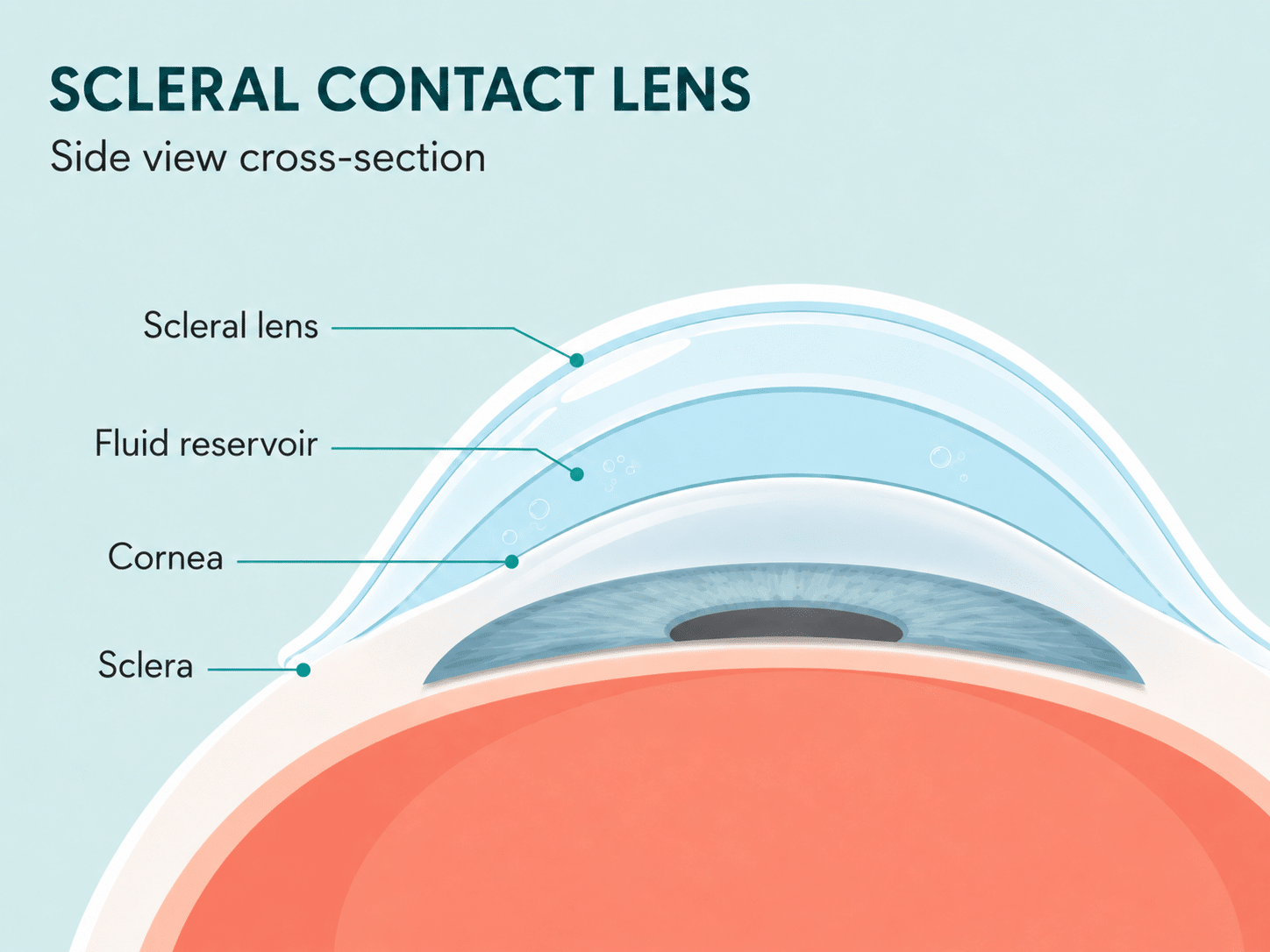
A larger lens that vaults over the cornea and rests on the white of the eye, with a fluid-filled chamber underneath. Often life-changing for keratoconus, severe dry eye, post-surgical irregularity, or any cornea that doesn't tolerate a standard contact. They sound complicated. Most patients adapt within a couple of fittings.
Learn more about scleral lenses →Multifocal specialty lenses
For patients who need both specialty correction and reading vision, available in custom soft and GP designs.
Gas-permeable (GP) lenses.
GP lenses get mistaken for the old "hard" contacts a lot, but the resemblance mostly ends at rigid. Modern GP lenses are a breathable, oxygen-permeable material, nothing like the PMMA plastic used decades ago. Because a GP lens holds its shape between blinks instead of flexing the way a soft lens does, it can deliver sharper, more stable vision, especially for higher prescriptions, significant astigmatism, and corneas that aren't perfectly regular. We build every GP lens from a topography map of your own cornea using WAVE CorneaLens, not a stock curve.
GP lenses aren't usually the first lens we reach for. Soft lenses are more comfortable out of the gate. But they're a strong option when a soft lens isn't holding up: higher prescriptions, irregular corneas, or dry eyes that soft lens materials don't tolerate well. They take longer to adapt to than soft lenses, typically one to a few weeks, and patients who've tried and given up on GP lenses before are often good candidates for a second look; the problem is frequently the fit, not the lens. With proper care, most patients get a full year of wear before we replace the pair.
GP contact lens fittings typically run $300 to $600 depending on complexity. Vision insurance (VSP or EyeMed) applies a materials allowance to GP lenses, and fitting-fee coverage varies by plan. We verify your specific plan before your appointment so you know what to expect.
What a specialty contact lens fit looks like.
A specialty fit takes longer than a standard contact lens exam. We don't charge for follow-up fittings during this process. We work with you until the lenses are right.
-
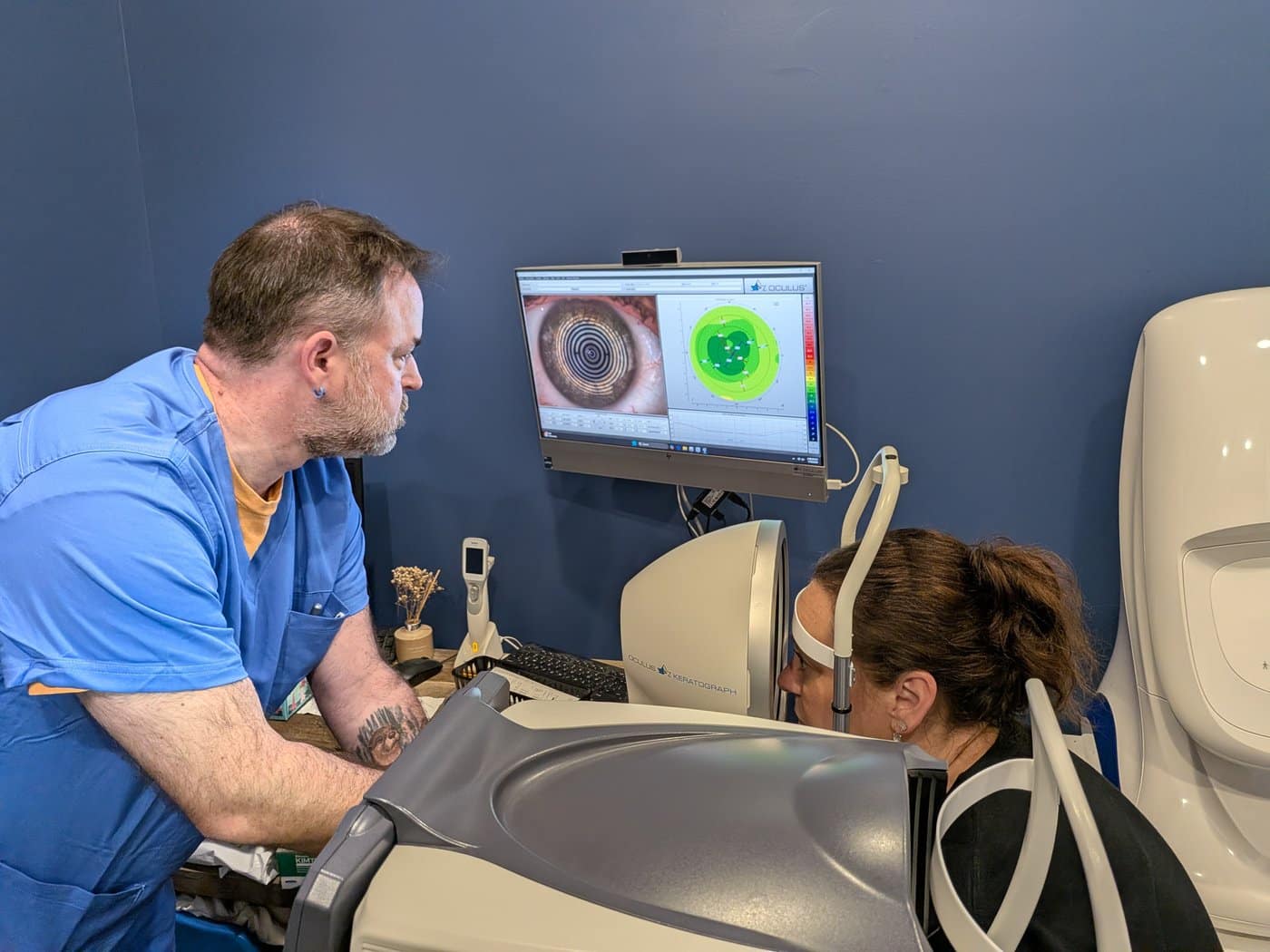
01Corneal topography. We start with corneal topography to map the surface of your eye, evaluate tear film and ocular surface health, and discuss what's worked and not worked for you in the past.
-
02Trial lens design and wear. We design or order a trial lens, you wear it, we evaluate the fit and vision, and we adjust.
-
03Refinement until it's right. Some patients are dialed in on the first or second lens; others go through three or four iterations to land on the right design. We don't charge for follow-up fittings during this process. We work with you until the lenses are right.
Insurance and medical necessity.
When a specialty lens fit qualifies as medically necessary, most major vision plans (VSP, EyeMed) include a Medically Necessary Contact Lens benefit that applies, and the coverage is significantly better than what vision plans pay for "elective" contacts. The benefit is part of your vision plan, not your medical plan; whether your specific case qualifies depends on the diagnosis and your plan's rules.
- Whether your specialty lenses qualify depends on the diagnosis (keratoconus, post-surgical, severe dry eye, etc.), your specific plan, and the documentation.
- Our team verifies your coverage before you commit, so you know what to expect.
If you've been told you're "hard to fit," or you've tried contacts and given up, give us a chance to take a look.
We see patients from New Albany, Gahanna, Westerville, Johnstown, and across Central Ohio. There may be a lens design that fits your eye better. Finding it takes the right tools and the patience to dial it in.
Schedule a specialty lens consultation.
If you've been told you're "hard to fit," or you've tried contacts and given up, give us a chance to take a look. We see patients from New Albany, Gahanna, Westerville, Johnstown, and across Central Ohio.
Related reading: Scleral contact lenses → · What scleral lenses cost → · Contact lens exams at COVE → · Contact lenses overview → · COVE Plus Sclerals: flat-price program → · Six signs your contacts never feel right → · Living with keratoconus: what scleral lenses do →