

Blog

Why Headlights Glare at Night (and What Actually Helps)
You’re driving home after dark. An oncoming car crests the hill, and its headlights burst into a starry blur that takes a second or two to clear. Streetlights wear halos. Wet pavement throws light everywhere.
If that sounds familiar, you have company. In a 2026 AAA survey of U.S. drivers, about six in ten said headlight glare is a problem for them at night, and most of those said it has gotten worse over the past decade. Drivers who wear prescription glasses reported it more often.
Here’s what’s going on, and what you can do about it.
Your eyes work differently at night
In bright light, your pupils are small. At night they open wide to gather as much light as they can. A wide pupil lets light through more of your eye’s optics, including the outer edges, and that’s where small focusing errors show up.
That means you effectively have a daytime prescription and a nighttime one. The difference is subtle, more like going from A vision to B vision than anything dramatic, and for many people it never matters. Others are sensitive to it, and glasses designed mainly for daytime can leave the road a little less crisp after dark. Think of it as hard mode. The shift is harmless, and night driving just asks a bit more of your eyes.
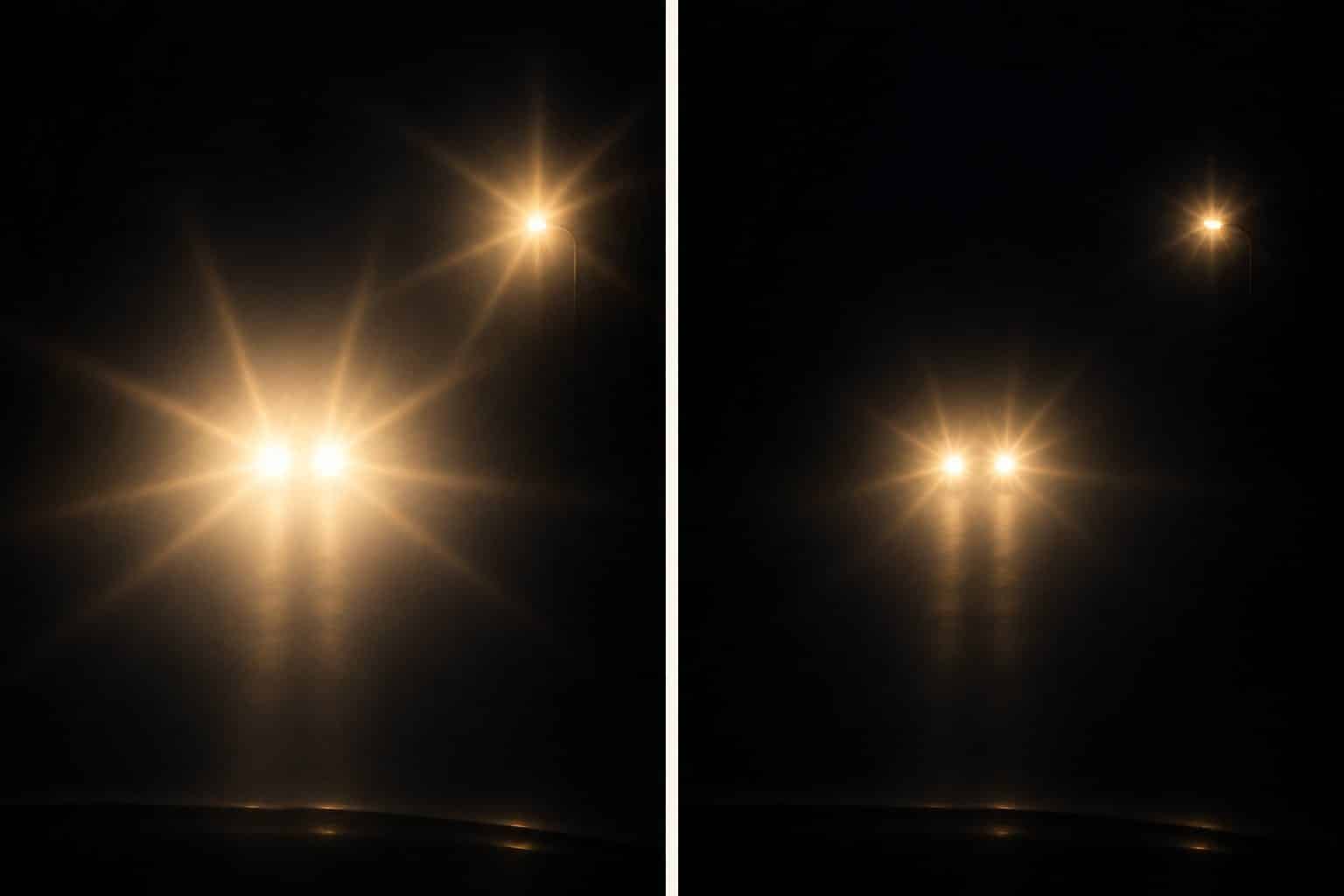
What turns headlights into halos and starbursts
Several different things can make headlights harder to look at. Some blur the focus of each point of light, some scatter it, and some add reflections.
A prescription that’s slightly off. A small change you’d never notice reading a sign at noon can show up clearly around headlights at night.
Your lenses. Fingerprints, smudges, and scratches scatter light. Reflections off the front and back of your lenses can add faint ghost images. An anti-reflective coating cuts those reflections and lets more light through.
Dry eye. A healthy tear film is the first surface light passes through. When it breaks up, vision may blur between blinks and glare may get worse. Concentrating on a long drive can reduce blinking and make dryness worse.
Changes inside the eye. As we age, the natural lens inside the eye can slowly become less clear, and early cataract changes can show up as glare at night. It’s one of the things a comprehensive eye exam checks.
Subtle astigmatism. Many people have a small amount of astigmatism that causes no trouble in daylight. When pupils are larger, and at night in general, many people become more sensitive to it, and it can stretch points of light into streaks and starbursts. Our guide to reading your glasses prescription explains what the astigmatism numbers mean.
The headlights themselves. AAA’s survey found that oncoming headlights are by far the most common source of glare drivers report, and AAA pointed to newer headlight technology and taller vehicles as factors that can contribute.
What actually helps
Keep your prescription current. An updated prescription may improve nighttime clarity, and a night complaint is worth mentioning at your exam even if daytime vision seems fine.
Choose an anti-reflective coating. It can reduce the reflections and ghost images you see from your own glasses.
Consider a driving lens. Some lenses are designed specifically for low light and take larger nighttime pupils into account. We fit them in single vision and progressives; see our night driving glasses page for the options.
Clean your lenses and your windshield, inside and out. Both scatter headlights the same way.
Dim your dashboard and look toward the right edge of your lane when a bright car approaches, so you’re not staring into its lights.
The best we can usually do is give you the sharpest image possible. If an oncoming driver has their bright lights on in the middle of the night, no lens fixes that one.
Do yellow night driving glasses help?
The evidence doesn’t support them. In a 2019 driving-simulator study published in JAMA Ophthalmology, drivers wearing yellow-lens night driving glasses spotted pedestrians no sooner than with clear lenses, and the lenses did not lessen how much headlight glare slowed them down. The authors concluded the results don’t support recommending them. A tint cuts the total light reaching your eyes, and at night you need every bit of it. A clear lens with the right prescription and a good anti-reflective coating is the better place to start.
When to come in
If night driving has gradually gotten harder, or one eye seems worse than the other at night, it’s worth an exam. We’ll check your prescription in detail, look at your tear film and the health of your eyes, and talk through what would help, whether that’s an updated prescription, a coating, a driving lens, or something else.
Drs. Karres, Keller, and Dennis see patients at our New Albany office. Call (614) 933-0575 or book your exam online.

If night driving has gotten harder, an eye exam is a good place to start.
Or call us at (614) 933-0575. We see patients from New Albany, Gahanna, Westerville, Johnstown, and across Central Ohio.