
Soft Contacts · Daily, Astigmatism & Multifocal · COVE New Albany

Soft Contact Lenses in New Albany, OH

Everyday lenses, astigmatism, and reading correction. Fit by Dr. Karres, Dr. Keller, and Dr. Dennis.

Soft contacts are what most people picture when they think of contact lenses, and they cover far more than plain nearsightedness. Astigmatism, reading correction after 40, and a wide range of prescriptions are all handled by a soft lens for most patients.

This page covers all of it. If your eyes need something a soft lens can't do, that's a specialty fitting, and it lives on its own page.

Schedule a contact lens exam.
01
The Basics

The two kinds of soft contact lens.

Daily disposables are worn once and thrown out that night. No cleaning, no case, no solution. A fresh, sterile lens every morning.

Reusable lenses are worn again after nightly cleaning and disinfecting. They come in weekly, biweekly, and monthly replacement versions. The differences between those three are smaller than most people expect; the bigger difference, for your eyes and your routine, is daily versus reusable. Weekly lenses exist, but they're an option we rarely reach for at COVE.

Every reusable lens builds up deposits from tears and handling over its life, and every night in a case is a chance for contamination if the cleaning routine slips. That's the trade you're making for a reusable lens, and it's why the daily-versus-reusable decision is the one worth thinking about.

02
Our Default

Why daily lenses are our default.

Whenever a daily lens is available in your prescription, that's what we recommend. Three reasons:

More comfortable, and it stays that way

This is the one patients actually feel. A reusable lens starts out fine, but comfort slips as deposits build. Many patients stretch a lens past its replacement date, and the pattern is familiar: still pretty good through the first couple weeks, starting to fade around day 20, uncomfortable by day 30, and by day 45 just trying to get by until the next pair. Replacing on schedule keeps lenses comfortable. A fresh daily lens skips that decline entirely. It is also more hygienic, straight from the blister pack with no case or solution involved, which is a big part of why it stays comfortable.

More convenient, day to day

No lens case to keep track of, no nightly cleaning and disinfecting routine, no bottle of solution to spill in a bag or a hotel bathroom sink. Wear it, throw it away, done. A reusable lens asks for all of that upkeep, every single night, for as long as the lens lasts.

The cost gap often evens out

Dailies look more expensive on box price alone. But reusable lenses need a year of contact lens solution and cases on top, and dailies don't. Once you count everything, the real difference is often smaller than expected, and annual-supply rebates can narrow it further.

03
The Fallback Lane

When reusable lenses make sense.

Reusable lenses are the answer when a daily lens isn't an option, whether that's your preference or your prescription:
A high or unusual prescription. Very strong nearsighted or farsighted corrections, or an uncommon combination of numbers, sometimes aren't manufactured as a daily disposable at all. Reusable designs cover a wider range.
Significant astigmatism. Toric daily lenses work well for most people, but more demanding astigmatism corrections often need a reusable toric design for a stable, comfortable fit.
A multifocal correction. Some multifocal designs, especially ones that also correct astigmatism, are only made as reusable lenses.
An advanced prescription that needs a custom lens. For some advanced or irregular prescriptions, including certain cases of keratoconus, a custom soft lens replaced quarterly can be an option when a scleral or gas-permeable lens isn't a good fit or isn't well tolerated. These lenses are made specifically for that eye. See our specialty contact lens page for more.
Your preference. Some patients simply prefer a reusable lens and take good care of it. That's a legitimate choice, and we'll fit it well. We'll also be straight with you about the cleaning routine it commits you to.
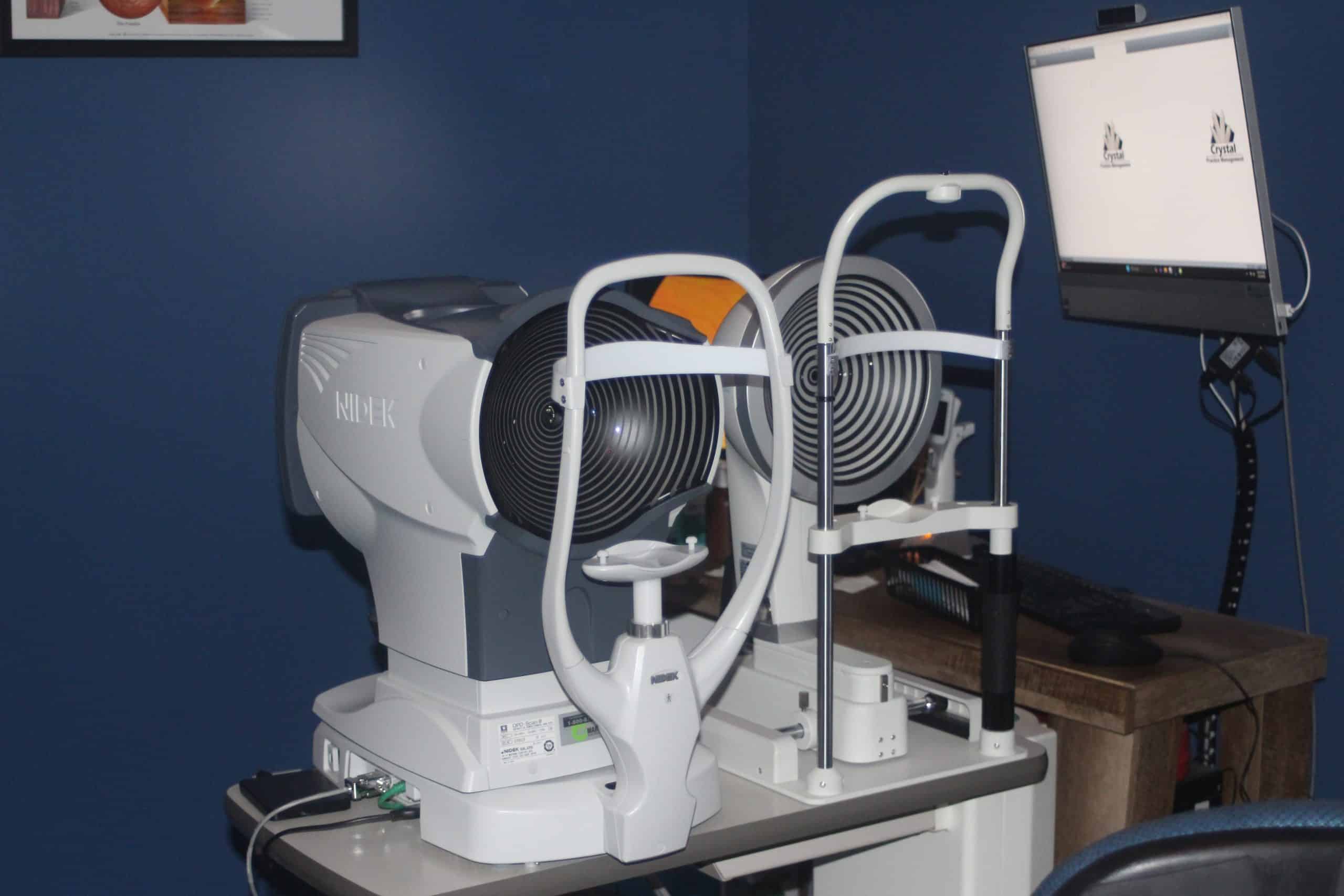
Corneal topographer used at Central Ohio Vision and Eyecare in New Albany to map corneal curvature and determine the right contact lens fit
We map your corneal curvature during your contact lens exam. It is one piece of the picture, read together with the rest of your exam, and it helps us choose how to correct your astigmatism and whether a daily lens will work for you or a reusable design fits better.
04
Astigmatism

Soft lenses for astigmatism.

Astigmatism happens when the cornea, or occasionally the lens inside the eye, is shaped more like a football than a basketball. Instead of one clear focal point, light focuses at two, which blurs vision at every distance rather than just up close or far away. It's extremely common and it's not a disease. Most people have some degree of it.

Astigmatism does make contacts harder, but it isn't a reason to give up on them. Toric soft lenses correct most astigmatism well, and they come as dailies, biweeklies, or monthlies. This is where most astigmatism fittings begin, and it's where most patients stay. The lens has to hold its orientation on the eye, so the fit takes a bit more care than a standard round lens.

If you've been told your astigmatism is "too much" for contacts, it's worth a second look. More often than not the issue is the lens design, not your eyes.

Regular astigmatism. A smooth, symmetrical curve, just an uneven one. It corrects predictably with glasses or standard toric contacts. Most patients in this group do well in toric soft lenses, and many who assume contacts "won't work" for their astigmatism haven't actually tried a modern toric lens.
How much astigmatism you have. Low to moderate amounts fit predictably into standard toric designs. Higher amounts narrow the field, and that's where rigid gas-permeable or scleral options tend to perform better. Soft toric lenses rotate slightly with every blink; a rigid lens generally doesn't.
Irregular corneas. Keratoconus, post-surgical corneas, and scarring create astigmatism that doesn't correct predictably in glasses or soft lenses. If this describes your eyes, a specialty lens evaluation is the right next step, not a standard toric fitting. See our specialty contact lens page for what a scleral fitting involves.
05
Reading Correction

Multifocal lenses for reading correction.

If you've been told you can't wear contacts anymore because you need reading glasses, that's not quite right. Presbyopia is what happens as you move through your 40s: the lens inside your eye gradually loses flexibility, making close focus harder. Multifocal contacts are the contact-lens equivalent of progressive glasses, with the correction built into the lens itself, so you're not pulling readers on and off all day.

Most designs use concentric rings or gradients, with different zones for different focal distances. Your visual system learns to select the right zone depending on what you're looking at. Adaptation takes a few weeks for most wearers, but once the fit is dialed in, many patients forget they're wearing anything different from their regular contacts.

Multifocals take more expertise to get right than a standard contact lens. If you've tried them before and given up, the problem was likely the fit, not the technology.

Soft multifocal lenses. The most common starting point. Daily, biweekly, and monthly options exist. They're comfortable from day one for most patients and work well for people with healthy, regular corneas. This is where most multifocal fittings begin.
Your prescription and your corneas. High prescriptions and strong near corrections can narrow which designs work best. Irregular corneas or significant dry eye often reduce success with soft multifocals; gas-permeable or scleral multifocal options typically work better for those patients, and we fit those too. See our specialty contact lens page.
Your visual demands. Multifocal contacts involve a tradeoff. Night driving contrast and very small print are the most common compromises. Most wearers find the tradeoff acceptable once they understand it going in. If your needs require absolute sharpness in every condition, a dedicated pair of distance or reading glasses may still have a role alongside your contacts.
A note for parents. If you're here looking for myopia control contacts for your child, that's a different category. Dual-focus lenses are designed to slow myopia progression in kids, not to correct reading vision. See our myopia management page for options for children whose prescriptions are changing.
06
The Economics

Annual supplies, rebates, and financing.

How you buy your lenses changes what you pay. Manufacturer rebates on a full year's supply are often substantial, and we frequently have access to very good ones, which can make an annual supply of daily lenses cost less per day of wear than buying box by box.

If the upfront cost of a year's supply is the obstacle, CareCredit financing is available. Ask us at your visit and we'll walk you through what applies to your order.

Your vision plan factors in too: VSP and EyeMed both provide a materials allowance that applies toward your lenses, whatever kind you wear. We verify what we can in advance and confirm your plan details together at your appointment.

Buying a year's supply

Buying a year of contacts? Ask about the COVE Update Program.

Contact lens wearers still need a pair of glasses, for the end of a long day, for an eye infection, for the mornings you don't want to bother. Buy a full year's supply of daily disposable contacts, and the COVE Update Program puts new single-vision poly lenses in your own frames at no charge. On an annual supply of monthly or two-week lenses, the same lenses run about $95.

Premium and progressive lenses aren't included, but we're happy to price those out too. We'll confirm what applies to your prescription and frames at your visit.

07
The Practice

How we decide at COVE.

Soft lens fitting is everyday work for our doctors. Dr. Karres, Dr. Keller, and Dr. Dennis all fit soft, toric, and multifocal lenses, so you can book with whichever doctor and time works for your schedule.

Your contact lens exam is where we figure out which lens actually fits your eyes. That means measuring your corneal curvature, checking your tear film, and talking through how you actually wear contacts day to day.

If a daily lens can do the job, that's what we'll recommend. If your eyes or your prescription point toward a reusable design instead, or toward a specialty lens altogether, we'll walk you through why.

Wide-field retinal imaging camera at Central Ohio Vision and Eyecare in New Albany, part of every contact lens exam
Whichever lens you land on, every contact lens exam at COVE includes a look at your overall eye health.
08
Questions

Frequently asked questions.

Q.01 Can I wear contacts if I have astigmatism? +
Yes, most patients with astigmatism can wear contacts comfortably. A standard soft lens corrects the same power in every direction; a toric lens has different power built in along different axes, matching the shape of an astigmatic eye, and it's designed to hold a specific rotation so the correction lines up consistently. Toric soft lenses correct regular astigmatism well and come in daily, biweekly, and monthly options. Higher amounts of astigmatism or an irregular cornea may point toward a gas-permeable or scleral lens instead, which we'll determine at your fitting.
Q.02 I tried toric lenses before and my vision blurred when I blinked. What happened? +
That's usually a rotation problem: the lens isn't settling in the same orientation every blink, so the astigmatism correction briefly falls out of alignment. It's often solvable with a different toric design or a fitting adjustment. For higher astigmatism where soft lenses keep struggling to stay put, a gas-permeable lens, which doesn't rotate the same way, is often the better fit.
Q.03 Can I wear multifocal contacts if I have astigmatism? +
Yes. Multifocal toric lenses correct both presbyopia and astigmatism. For patients with significant astigmatism and irregular corneas, gas-permeable or scleral multifocal lenses often deliver better results than soft multifocal torics, because the rigid lens optics handle irregular surfaces better.
Q.04 I tried multifocal contacts years ago and they didn't work. Should I try again? +
Yes, it's worth revisiting. Soft multifocal designs have improved significantly in the past decade, and fitting protocols are more precise than they used to be. Many patients who gave up on multifocal contacts 5 to 10 years ago do much better with current options. Give adaptation a fair window: most patients stabilize in soft multifocals within 2 to 4 weeks, and gas-permeable multifocals take closer to 4 to 8 weeks. If it isn't happening after that, the fit needs to be re-evaluated, not abandoned.
Q.05 Do multifocal contacts work for computer use? +
Many designs handle intermediate distance (computer range, roughly 20 to 24 inches) well. Some designs handle it better than others. During the fitting, we ask about your visual demands specifically, what you're doing most and where you spend most of your time looking, and match the lens design to your actual daily use.
Q.06 Are daily contacts really more expensive than reusable lenses? +
Often not by as much as the box price suggests. Reusable lenses need a year of contact lens solution and cases on top of the lenses themselves, and dailies don't. Add manufacturer rebates on an annual supply, which are often substantial, and the real gap is frequently smaller than expected. Buying the year at once also means you never stretch a lens past its life because the next box hasn't arrived. If the upfront cost is a concern, CareCredit financing is available. We'll price out your specific options at your visit.
Q.07 Can kids wear toric contacts for astigmatism? +
Often, yes, once a child is ready for the responsibility of contact lens care generally. Astigmatism itself isn't a barrier. Whether a child is ready depends on the child, not the age, and it's a decision the family makes with us together. If your child is also being monitored for myopia progression, see our myopia management page for how astigmatism factors into those options.
Q.08 Does vision insurance cover soft contact lenses? +
VSP and EyeMed both cover a contact lens exam and provide a materials allowance that applies toward your lenses, whether they're standard, toric, or multifocal. The exact allowance and any fitting fee depend on your specific plan. If your astigmatism is irregular and tied to a diagnosis like keratoconus or prior corneal surgery, a scleral or gas-permeable fitting may qualify for the Medically Necessary Contact Lens benefit instead, which typically brings your out-of-pocket down to a small copay. Either way, we verify what we can in advance and confirm the specifics together at your appointment.
Next Step

Schedule a contact lens exam.

Whether you're new to contacts, wondering if your astigmatism rules them out, or tired of reaching for readers, the best first step is a contact lens exam. We'll map your corneas, review your prescription, and talk through how you actually use your eyes, then start with the lens that fits. We see patients from New Albany, Gahanna, Westerville, Johnstown, and across Central Ohio.

Related reading: Contact lens exams at COVE →  ·  Specialty contact lenses →  ·  Myopia management for kids →