

Blog

What Do the Numbers on Your Glasses Prescription Mean?
A prescription card can feel like a wall of abbreviations: OD, OS, SPH, CYL, AXIS, and ADD, followed by columns of plus and minus numbers. If you just left an eye exam in New Albany and want to know what the numbers on your glasses prescription mean, start with the rows and read across. This guide walks through the card from top to bottom, including the measurements that may be missing and the values that belong on a separate contact lens prescription.
The layout: OD, OS, and OU
Start with the eye labels. OD is your right eye, short for the Latin oculus dexter. OS is your left eye, from oculus sinister. OU means both eyes, from oculus uterque, and appears when one entry applies to both.
OD is conventionally the top row. Some cards use Right and Left in place of the Latin abbreviations. Each row describes one eye, and the values may differ, so read each row on its own as you move across the columns.
Sphere: the main number
Sphere, often shortened to SPH, is the main focusing power. A minus number means nearsightedness. A plus number means farsightedness. The farther the number sits from zero in either direction, the stronger the lens.

That power is measured in diopters, written D. A +1.00 D lens focuses parallel light at one meter, while +2.00 D focuses it at half a meter. Your sphere mostly reflects the length and shape of your eye and age-related changes in its focusing lens.
A stronger prescription does not mean your eyes are failing or that you will see worse in glasses. Higher levels of nearsightedness are associated with greater lifetime risk for certain eye conditions, which is one reason doctors follow changes over time, especially in children.
Cylinder and axis: the astigmatism pair
Astigmatism means the cornea or the lens inside your eye curves more in one direction than another. Picture the difference between a basketball, which curves similarly in every direction, and an American football, which has two different curves. The difference in an eye is much subtler. Astigmatism is common, and you did nothing to cause it.
Cylinder, or CYL, measures the amount of that curve mismatch. Axis gives its direction in degrees across a half-circle. An axis of 175 is no stronger than an axis of 5. The small “×” before the axis reads as “at,” so −1.00 × 090 means one diopter of cylinder at axis 90.
The direction matters because cylinder power has to line up with the eye’s curve. The right amount aimed in the wrong direction leaves the two focal lines apart. That is why the flipping lens and the “better one, or two?” choices during an exam help refine both cylinder and axis.

Cylinder can be written in plus form or minus form, and transposition converts one form into the other. Two cards may therefore look quite different while describing the same eye. COVE writes cylinder in minus form on printed prescriptions, so the examples in this article match the card you receive from us. For a visual version, explore how sphere, cylinder, and axis bend light in COVE’s interactive optics bench.
Add: the number that shows up in your forties
ADD is extra plus power for close work, placed on top of your distance prescription. It usually appears when presbyopia becomes noticeable, somewhere from the early to late 40s. The eye’s internal focusing lens gets harder and less flexible with age, so shifting focus to reading distance becomes more difficult. Presbyopia is a normal part of aging that everyone develops.
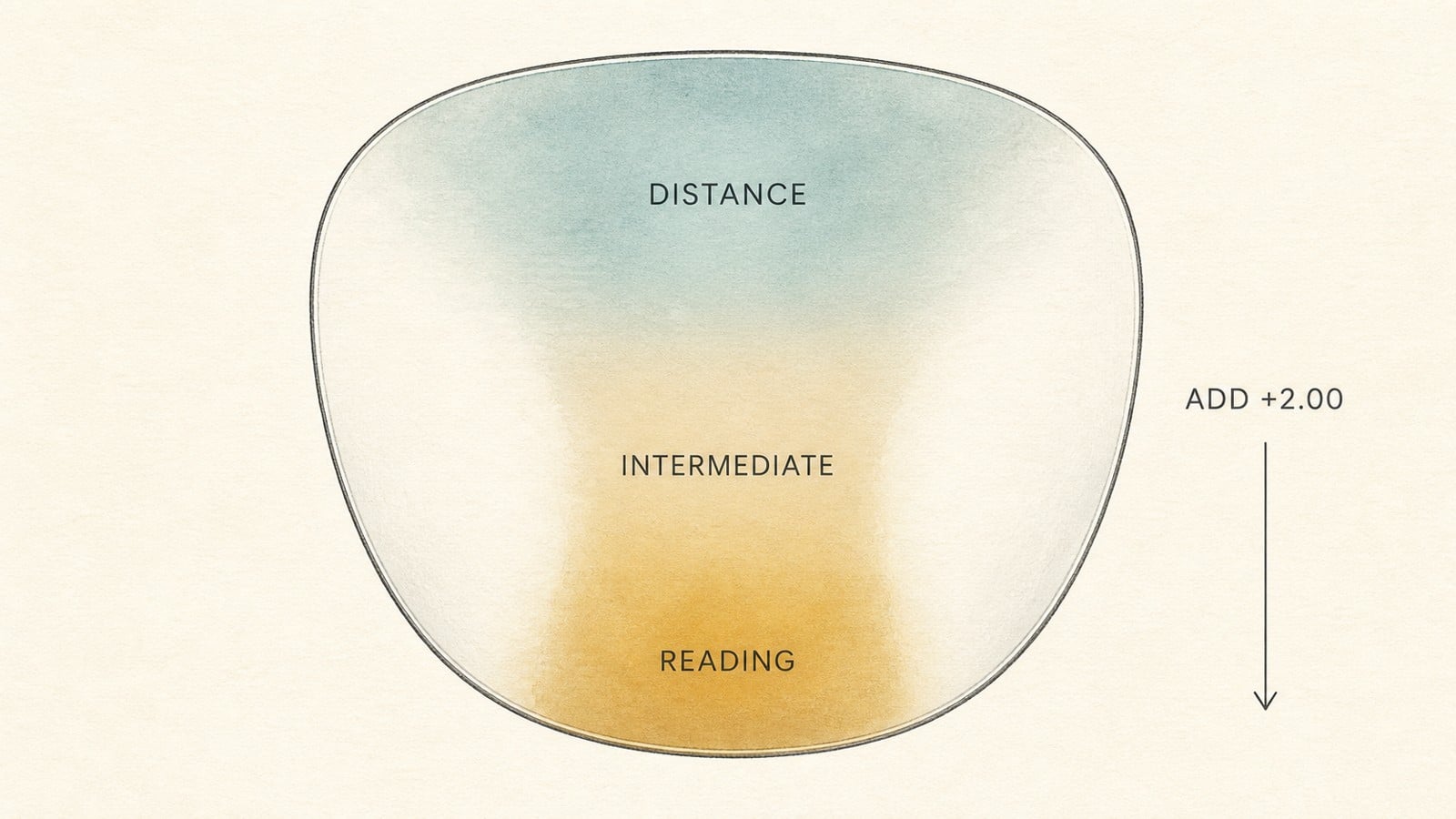
If the card shows one ADD value for both rows, that value supplies the same near boost to each lens. In a bifocal, the add becomes the lower reading segment. In a progressive, the add becomes a gradual shift between distance and reading power. See how progressive-lens measurements and fitting height shape the finished lens.
Distance power sits at the top of a progressive lens, reading power sits at the bottom, and the add builds through the corridor between them. Vision is softer at the sides, where those changing powers blend.
Prism, and a blank cylinder box
Most prescriptions have no prism. When it appears, prism may help two eyes that are misaligned bring separate images together. The amount is measured in prism diopters. Base In, Base Out, Base Up, or Base Down names the direction of the wedge’s thick edge.
SPH or DS in the cylinder field means no cylinder power is written, so an axis is unnecessary.
The measurement that is usually missing: PD
PD means pupillary distance. A binocular PD is one number measured from pupil to pupil. A monocular PD gives two numbers, one from the bridge of the nose to each pupil.

PD often is not printed on the prescription because it is a fitting measurement, separate from the refractive correction. The lab uses it to place each lens’s optical center in the frame you chose. Poor centering can create unwanted prism and may cause blur, distortion, eyestrain, discomfort, or headaches.
We cut, edge, and finish lenses in our New Albany lab whenever we can. Some frames are not practical to cut in the office, and some insurance plans require us to send the job to a lab they specify. Read about frame anatomy and the measurements behind a well-fitted pair of glasses and see how prescription and fitting measurements guide our in-house lens lab.
Two things your prescription is not
First, your prescription is not your 20/20 measurement. Visual acuity records how clearly you read a chart at a set distance. In 20/40 vision, you read at 20 feet what a standard-vision eye reads at 40 feet. Prescription power describes the lens needed to focus light. The two values do not convert into each other. A 20/20 result is a normal reference standard, and people can see better than 20/20.
Second, a glasses prescription cannot be used to order contact lenses. Glasses sit in front of the eye, while a contact lens sits directly on it, so vertex distance can change the required power. A contact lens prescription also includes its own base curve, diameter, material, and brand after a fitting. It is a separate legal document. Our guide to soft contact lenses, including lenses for astigmatism explains the options in more detail.
Your prescription belongs to you and may expire
The federal Eyeglass Rule requires the prescriber to give you a copy immediately after the refractive exam, before offering to sell glasses, whether you ask for it or not. You do not have to buy glasses from the office that performed the exam, and there is no extra fee for releasing the prescription. You may be asked to sign that you received it as part of federal recordkeeping.
Federal law sets no expiration date for glasses prescriptions. In Ohio, an optometrist may set a spectacle prescription to expire at up to two years under normal circumstances, or sooner for a documented clinical reason. Expiration sets a review interval. It does not prove that your numbers changed.
Bring us the card you are reading
Your prescription should be readable by you. During a routine eye exam at COVE, our doctors are happy to explain each value and our optical team can show how those measurements become a finished pair of glasses.

Frequently asked questions
Q.01 Can I use my glasses prescription to order contacts?
No. Contact lenses sit directly on the eye, so their required power can differ from glasses because of vertex distance. A contact lens prescription also includes lens-specific information such as base curve, diameter, material, and brand. It is issued after a contact lens fitting and is a separate legal document.
Q.02 Does a stronger prescription mean my eyes are unhealthy?
The number measures how much lens power is needed to focus light. It does not predict how well you will see once corrected. Higher levels of nearsightedness are associated with greater lifetime risk for certain eye conditions, so regular exams and monitoring remain important, especially when a child’s prescription is changing.
Q.03 Why is my PD missing from my prescription?
PD is a fitting measurement used to place the optical center of each lens in your chosen frame. It is separate from the refractive correction and often is not printed on the prescription card. An optical team can measure one binocular PD or separate monocular PD values for each eye.
Q.04 How long is a glasses prescription valid in Ohio?
An Ohio optometrist may set a spectacle prescription to expire at up to two years under normal circumstances. A shorter period may be used when the optometrist has a documented clinical reason. Federal law sets no glasses-prescription expiration date, so the date on your own card controls when you need a new exam.
Q.05 Why do two prescriptions for the same eye look different?
Cylinder can be written in either plus or minus form, and transposition converts between the two forms while describing the same correction. Two cards can therefore look dramatically different even when the prescribed lens power has not changed. Your optometrist can confirm whether an actual change occurred.