

Blog
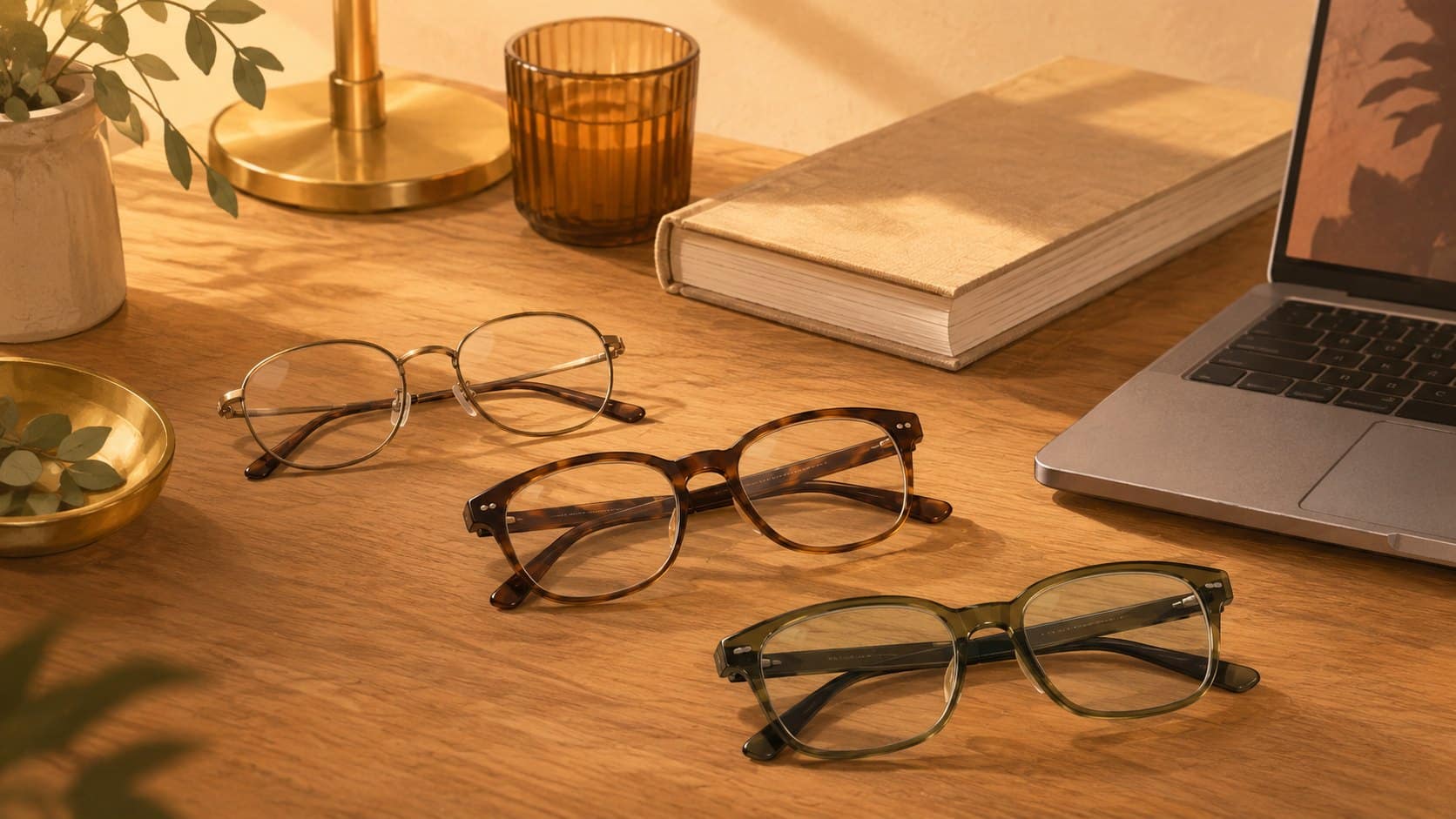
Reading glasses, progressives, or computer glasses: choosing by the work you do.
Reading a menu, working a spreadsheet, and driving home all ask your eyes to focus at different distances. The choice is really about where to put the power.
Presbyopia often becomes noticeable after 40, when near tasks start to need more focusing help. Reading a menu, working a spreadsheet, and driving home all ask your eyes to focus at different distances. If your prescription includes added near power, the next choice is how to place that power for the distances you use.
Reading glasses, progressives, and computer glasses put the right power in front of your eyes at the distance you use most. Here is how they differ, and how to think about which one fits your work.
The three distances that matter.
Your eyes work across three zones. Near covers close tasks such as a book or phone. Intermediate covers a computer screen, typically about 20 to 28 inches from the eyes, with the center of the screen 15 to 20 degrees below eye level, according to the American Optometric Association. Distance covers everything from across a room to across a parking lot.
A single-focus lens is optimized for one zone, with the others outside its usable range. That is fine if your day genuinely lives in one zone, and a problem if your day moves between all three, which is what pulls most people toward progressives or a dedicated computer pair.
Reading glasses: one job, done well.
Reading glasses are optimized for a close working range, adding near power for close tasks. Within that usable range, a reading pair can make print and small detail noticeably clearer. Look up at a screen across the room while wearing them, and things blur fast, because that is not the job they are built for.
That narrow focus is the appeal. For someone who reads for pleasure or works a hobby that is all close-up, a simple reading pair does exactly what is asked of it.
Drugstore readers and a prescribed pair.
Over-the-counter readers are a genuinely good option, and plenty of our patients use them. They are inexpensive, you can keep a pair in every room, and for a lot of casual reading they do the job.
What a prescribed pair adds is precision. We can land on your best reading power rather than the nearest half step on the rack, correct astigmatism, account for the two eyes being different from each other, and position the optics for where you actually hold your book or your screen. That is what makes print look genuinely sharp instead of merely bigger.
If you are buying a pair off the rack
The rough guidance I give patients is that a +1.00 sits at about arm’s reach, which suits a computer distance, and a +2.00 sits at about a foot and a half, which suits most reading. Start there and see what feels natural.
And if a power works for you, it is fine to use it. Readers in a power that is not perfectly matched to your eyes may not give you the sharpest or most comfortable vision, and they will not damage anything. You cannot hurt your eyes with the wrong pair of drugstore readers.
Progressives: multiple distances, one lens.
A progressive lens blends distance, intermediate, and near power into a single lens with no visible line, so your eyes shift through a gradient of power as you look around instead of switching lenses. For someone moving constantly between the road, a phone, and a conversation, that is a real convenience.
The honest tradeoff, per the American Academy of Ophthalmology: adaptation takes practice, and the sides of the lens carry more distortion than the corridor down the middle. Adjustment time varies. Some people feel comfortable quickly, while others need a few weeks. If vision still feels wrong or stairs feel unsafe, contact COVE so we can check the fit, measurements, and lens design.
That corridor is also narrower than a full screen for hours of continuous computer work, which is why some all-day desk workers pair progressives for daily life with a dedicated computer lens for the office. Our progressive lenses page covers fitting details and what to expect in the first days of wear.
Computer and office glasses: built for the middle distance.
Computer glasses are tuned for the intermediate zone, the 20-to-28-inch range where a screen usually sits. The AOA says people who spend two or more continuous hours a day at a computer or digital screen are at greatest risk for digital eye strain. If your regular glasses are not comfortable at your screen distance, a computer-specific prescription may help.
Common contributors to screen discomfort include sustained focusing effort, less frequent or incomplete blinking, an uncorrected prescription, glare, and a viewing distance or workstation setup that does not fit the task. A computer-specific lens addresses the distance directly.
Blue-light filters are a personal preference. Current evidence, including a Cochrane review and the American Academy of Ophthalmology, has not shown that blue-light-filtering lenses reduce computer eye strain.
Choosing by the work you actually do.
When you are choosing task-specific glasses, we measure the working distances that matter and use them to select the prescription and lens design. Most pairs are cut, edged, and finished in our own lab whenever the frame and your plan allow it.
If your current pair is not keeping up with your day, an exam that measures your real working distances is the place to start.
Or call us at (614) 933-0575. We see patients from New Albany, Gahanna, Westerville, Johnstown, and across Central Ohio.
Common questions.
Q.01Can progressives replace computer glasses for desk work?
For many patients, yes, especially with a mix of screen and in-person work. For someone at a screen for hours at a stretch, ask whether a computer-specific pair could provide a wider usable area, since it widens the usable intermediate zone that a progressive’s corridor narrows.
Q.02Do I need a different prescription for computer glasses?
Often, the lens power is adjusted for your working distance. We start with your underlying prescription, then account for where your screen sits and how you use it.
Q.03How long does it take to adapt to progressives?
Adjustment time varies. Some people feel comfortable quickly, while others need a few weeks. If vision still feels wrong or stairs feel unsafe, contact COVE so we can check the fit, measurements, and lens design.
Q.04Can over-the-counter reading glasses work instead of a prescribed pair?
For many people, yes. Readers are a good option and plenty of our patients use them. A prescribed pair adds your best reading power, astigmatism correction, an allowance for the two eyes differing, and lens positioning measured to you, which is what makes print look sharp rather than just bigger. As a starting point off the rack, a +1.00 sits around arm’s reach and a +2.00 around a foot and a half. A power that is not perfectly matched will not damage your eyes.
Q.05Can I use my vision insurance toward a second pair?
We discount second pairs, and if you have a vision plan we apply whatever second-pair benefit it includes. Your optician will go through the pricing with you.