
Bend light until the world snaps into focus.
COVE built an interactive optics bench. Drag a beam of light through a lens, watch the focus miss the retina, then dial in the correcting lens that lands it. Eight short modules take you from a single point of light all the way to astigmatism and color.
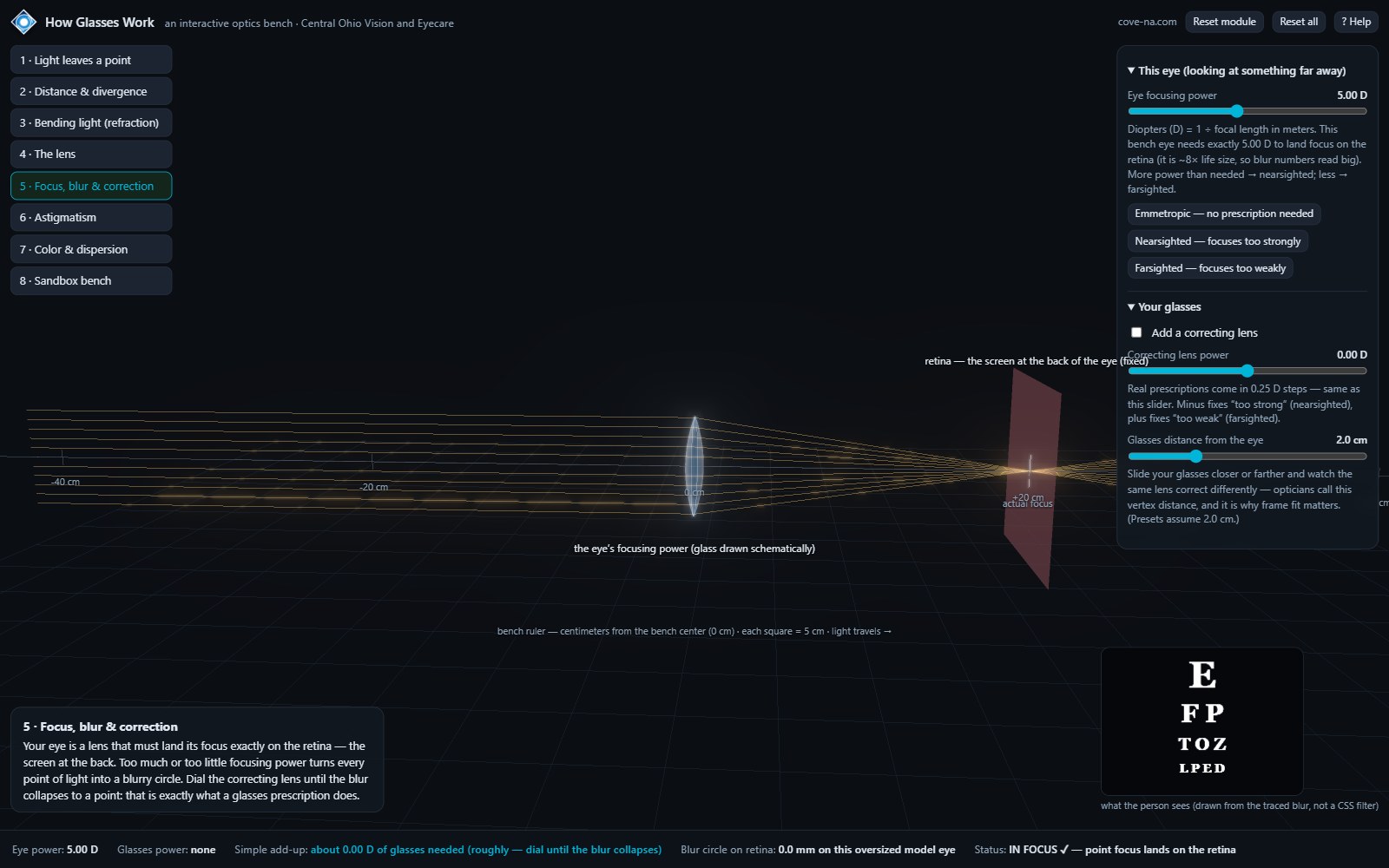
Why things look blurry.
Every point on everything you see throws off light in all directions at once. An eye with just the right focusing power gathers that scattered light and bends it back down to a single sharp point on the retina, the light-sensitive screen at the back of your eye.
When the focus lands a little in front of the retina or a little behind it, the image arrives as a fuzzy blob instead of a crisp point. That is really all nearsightedness and farsightedness are: the focus landing in the wrong spot.
A lens bends light, and that is its entire job. Its curve redirects incoming light by just the right amount so the focus lands on the retina. A nearsighted eye focuses too soon, so its lenses gently spread the light out first. A farsighted eye focuses too late, so its lenses start pulling the light together sooner.
Your prescription, in plain English.
Sphere is the main strength. A minus number corrects nearsightedness and a plus number corrects farsightedness; the farther the number is from zero, the stronger the lens.
Cylinder and axis describe astigmatism. An astigmatic eye is curved a bit more in one direction than the other, shaped less like a basketball and more like the back of a spoon, so it focuses light into two lines at slightly different depths instead of one point. Cylinder says how much of that mismatch there is; axis, a number from 1 to 180, says which direction it runs.
A sphere of -2.50 diopters to correct nearsightedness, -0.75 diopters of cylinder for astigmatism, set at axis 180. The bench's correcting-lens slider moves in the same 0.25-diopter steps most prescriptions use.
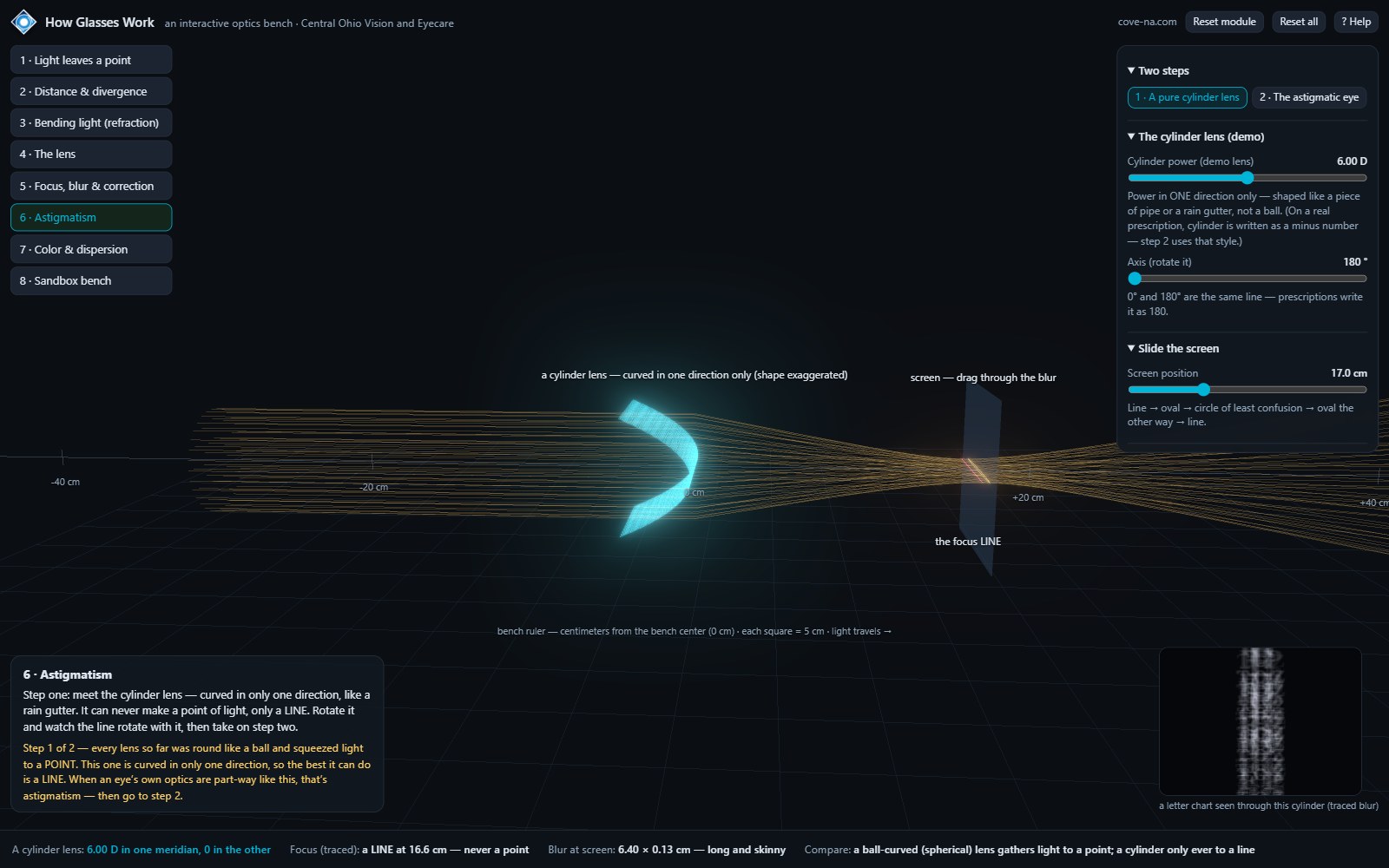
A cylinder lens can only ever focus light into a line. Rotate it and watch the line follow.
Open the optics bench →Common lens questions.
Do glasses make your eyes weaker over time?
No. Glasses simply bend light so you can see clearly while you wear them. Your prescription changes because your eyes change over time, not because you wore your glasses.
Why do two people with similar vision get very different prescriptions?
Because the numbers describe the specific bend each eye needs, and no two eyes are shaped alike. Usually your own two eyes differ from each other.
My glasses match my prescription but still feel off. Why?
A prescription is only the starting point. How the lenses are measured, made, and fitted to your face matters just as much, and that finishing work is where a good optical lab earns its keep.
When the numbers should make sense.
Your prescription should make sense to you. If you'd like someone to walk through yours, or you're due for an exam, we're glad to help.