Scleral lenses for high prescriptions & premium vision, in New Albany, Ohio.
If your prescription is strong enough that off-the-shelf soft contact lenses don't go that high, fit poorly, or don't correct your astigmatism reliably, you may have been told you're "too" something for contacts. There's often a different lens on the table.
Custom scleral lenses can be designed in very high powers, with high cylinder, and with more stable optics than soft contacts typically deliver. Patients with very high prescriptions may see clearer in sclerals than they were able to in glasses or soft contacts.
This page is also for patients who can already see "well enough" and want to see great: pilots, surgeons, photographers, and anyone else whose work or hobby depends on edge-case visual acuity. At COVE, every fit is custom-designed off your specific corneal topography, with two lens platforms we know and trust (Zenlens® and WAVE ScleraLens®), and we don't stop until the fit is right.
- When standard contacts can't deliver01
- Why scleral lenses deliver superior vision02
- Who this is for03
- A note for parents of high-myopic kids04
- What to expect on the eye chart05
- How the fit process works06
- Why two lens platforms07
- What it actually feels like08
- What it costs and insurance coverage09
- Why patients come to COVE10
- Frequently asked questions11
When standard contacts can't deliver.
Off-the-shelf soft contact lens manufacturers stock common prescriptions. Once your prescription leaves the common range, the manufacturers either don't make a lens that strong or only make a small selection in limited base curves. The result is the same regardless of which direction your prescription is extreme:
- Very high myopia (typically beyond -10 D, sometimes -15 to -20 D and higher): soft contacts may not be available in your power, or they don't fit the eye properly because the lens periphery is too thick.
- Very high hyperopia (typically beyond +6 to +8 D): similar story. High-plus soft lenses are uncommon and the optical quality often falls short of what glasses deliver, even though glasses themselves cause magnification and edge distortion.
- Very high astigmatism (typically 4 D of cylinder or more, especially when combined with high sphere): soft toric contacts above 2.75 D of cylinder are limited in availability, and even when they exist, the lens rotation on the eye makes the correction unstable.
If you've ever been told "you're a hard fit" or "we don't make contacts that strong," you've been describing this problem. It's a stock-lens problem, not an eye problem. Custom sclerals are not bound by stock-lens limitations.
Why scleral lenses deliver superior vision.
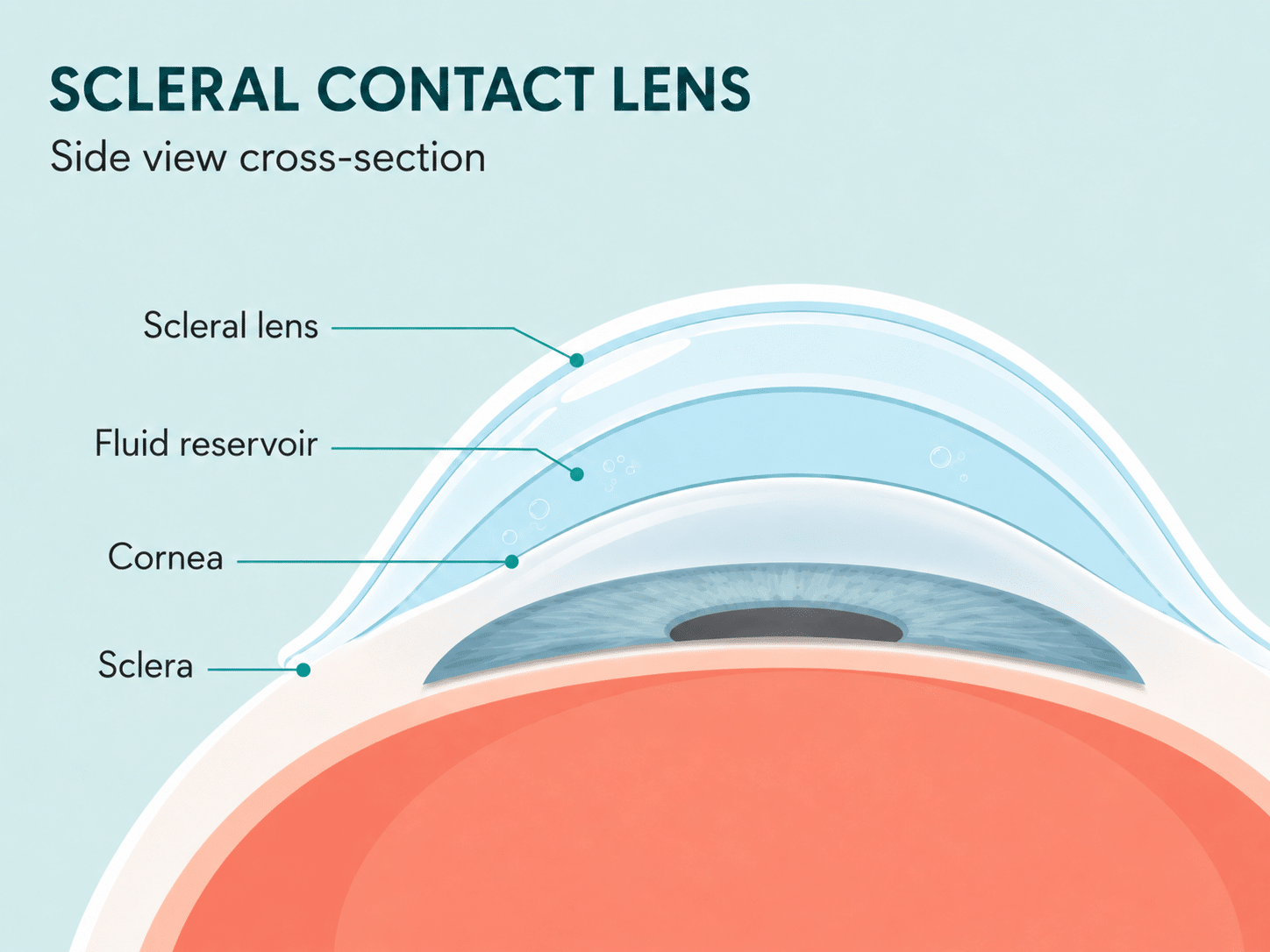
A scleral lens is a large, gas-permeable contact lens that vaults entirely over the cornea and rests on the white of the eye. The space between the lens and your cornea is filled with preservative-free saline. Three things make this design ideal for high prescriptions, and for anyone seeking the sharpest possible vision:
Every cornea also has higher-order aberrations: small irregularities in the corneal surface that distort the way light reaches the retina. Coma, trefoil, spherical aberration. They're invisible on a routine refraction but real, and they're a major reason two patients with the same prescription can have meaningfully different vision quality.
Custom power, no stock limit
Sclerals are made-to-order, not pulled from a manufacturer's catalog. Whatever prescription your eye actually needs, the lab can design and manufacture: high minus, high plus, high cylinder, and combinations well beyond what stock soft lenses offer.
Stable optics, even with high cylinder
Soft toric contacts rotate slightly on the eye every time you blink. With low cylinder, the rotation barely matters. With high cylinder, it matters a lot. Sclerals are too large to rotate meaningfully. Your astigmatism correction tends to stay where it was designed to be, blink after blink.
A smooth surface that replaces the cornea optically
The saline reservoir under the lens neutralizes the cornea optically. The fluid layer fills in microscopic irregularities; the lens front surface, not your cornea, becomes the optical surface. High-minus glasses minify the world; high-plus glasses magnify it. Sclerals sit on the eye and produce cleaner, edge-to-edge vision without those compromises.
For very high prescriptions, the practical difference is often dramatic. Patients describe seeing the world without the ring scotoma, without the magnified-or-minified feel, without the corner distortion they've lived with for decades.
Many leave their first follow-up reading lines on the chart they didn't know existed.
Who this is for.
Very high myopia
Prescriptions beyond -10 D, sometimes -15 to -20 D or higher. Glasses are heavy and minify the world; soft contacts may not come in your power or fit properly. Sclerals can be designed in extremely high minus powers without sacrificing optical quality.
Very high hyperopia
Prescriptions beyond +6 to +8 D. Glasses magnify and distort at the edges; off-the-shelf soft contacts in high plus are uncommon and optically compromised. Custom sclerals deliver clean, stable, edge-to-edge vision in powers other lenses can't match.
Visually demanding professions
Pilots, surgeons, photographers, video editors, dentists, professional drivers, marksmen: anyone whose work performance is bottlenecked by visual acuity. Sclerals often outperform soft contacts and glasses in side-by-side comparison.
"You've been told no"
If you've been told your prescription is too strong for contacts, or that you're "not a candidate," that's a stock-lens conclusion. Custom sclerals are usually a different answer. Worth at least a topography scan and a conversation.
A note for parents of children with high myopia.
If you're an adult with very high myopia and you have children, their myopia trajectory is worth watching closely.
High myopia tends to be heritable. The earlier a child's myopia starts and the faster it progresses, the higher their final prescription is likely to be, and high myopia carries lifelong risks (retinal detachment, myopic maculopathy, earlier cataracts, glaucoma) that are absolutely worth slowing.
We can't undo your prescription, but we can change your child's trajectory. Myopia management at COVE uses Ortho-K, MiSight contact lenses, atropine drops, and Stellest spectacle lenses to meaningfully slow childhood myopia progression, so your child doesn't end up where you are.

What to expect on the eye chart.
We're careful with the promises here. Every eye has an anatomical ceiling on how sharply it can ever see, and sclerals don't change that ceiling; they help you reach it.
What we tell patients honestly:
-
01Many patients gain measurable sharpness or stability in sclerals compared to their best glasses or soft contacts.
-
02Many see two lines sharper, particularly patients who had been topping out at 20/25 or 20/30 and didn't know why.
-
03Some see lines they didn't know existed. Patients who have always been "20/20 corrected" sometimes find they can read a bit further down the chart in sclerals.
-
04Vision stability is the bigger win for many. Even when the chart number doesn't change much, the vision feels different all day: no fluctuation, no end-of-day blur, no shift after a long screen session.
If your eyes are already at their anatomical limit in soft contacts, sclerals may not get you sharper on the chart. We'll tell you that during the consultation, based on the topography and the trial fit, rather than after you've paid for a fit.
How the fit process works.
High-prescription sclerals on healthy eyes typically fit predictably. The cornea is regular, and most of the work is in the lens design (getting the power exactly right) rather than in the corneal mechanics. Most fits land in 1–3 lens iterations.
-
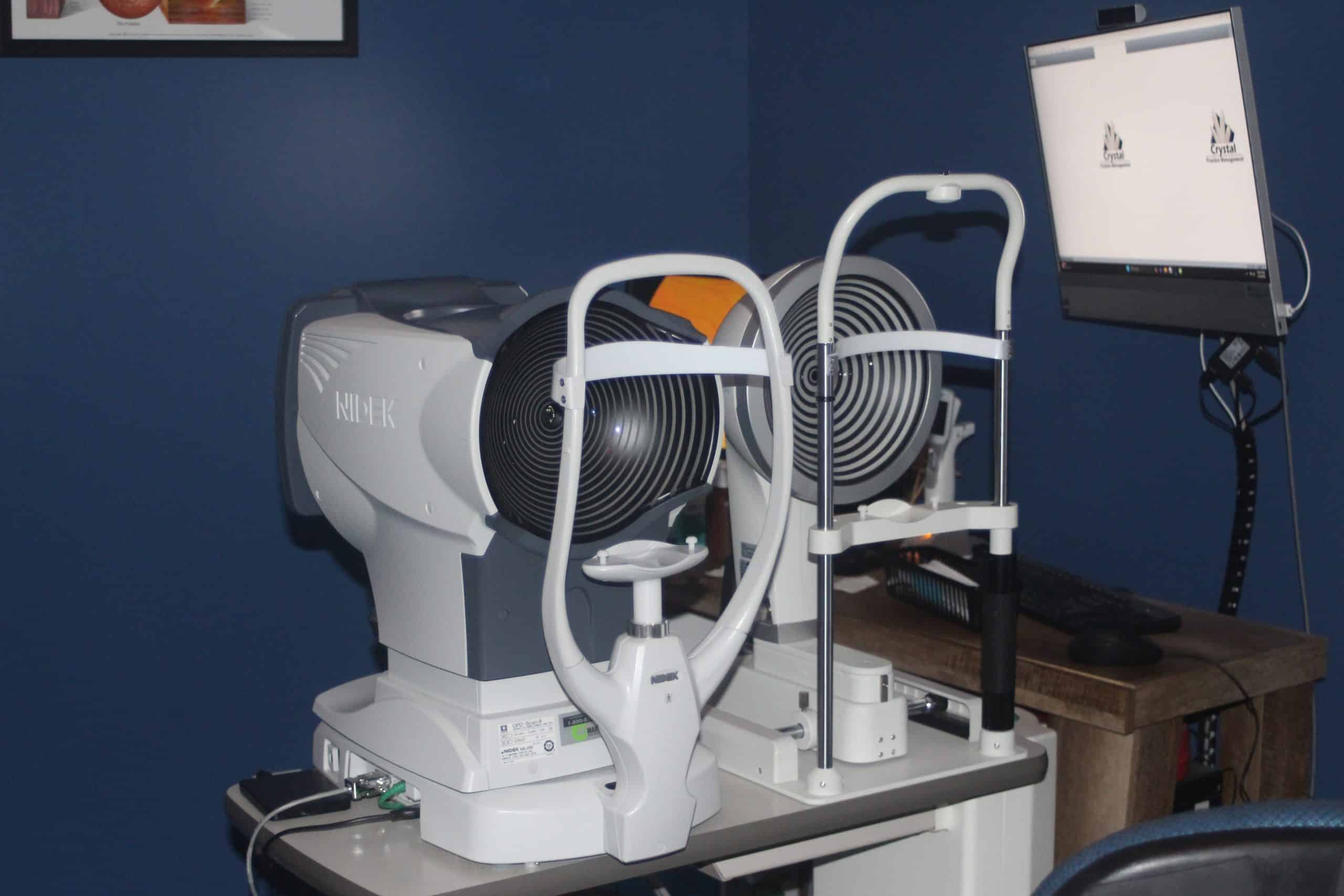
01Routine eye exam plus corneal topography on the Oculus Keratograph 5M. A precise map of your corneal curvature and any subtle irregularities.
-
02Anterior segment OCT. Cross-sectional imaging that lets us design the lens vault and edge geometry precisely for your eye.
-
03Lens platform selection. Zenlens® (diagnostic-trial workflow) or WAVE ScleraLens® (built directly from your topography map). For very high cylinder, the WAVE platform's topography-driven design can be especially useful; for premium-vision patients, WAVE can also incorporate higher-order correction directly into the lens design.
-
04Custom lens design. The lab manufactures to our specifications, including the exact sphere, cylinder, and axis your eye needs.
-
05Dispense and refinement. Most high-Rx fits take 1–3 lens iterations; premium-vision fits on healthy eyes typically take 1–2. The fitting fee covers all of those revisions; you do not pay per iteration.
Why two lens platforms: Zenlens® and WAVE ScleraLens®.
Most scleral practices fit one lens line. We use both, deliberately, because they're built around fundamentally different design philosophies, and for high-prescription and premium-vision fits, that difference matters.
Zenlens®: diagnostic-trial workflow
A diagnostic lens from our trial set goes on your eye. We evaluate the fit in real time and refine the order. A strong, fast option for healthy eyes that fit predictably.
WAVE ScleraLens®: built from your map
No diagnostic trial. The lens is designed in CAD/CAM software directly from your corneal topography and manufactured to that exact design. WAVE has been doing topography-driven scleral design since 1999. For very high astigmatism, the topography-driven workflow can deliver more accurate cylinder correction than a diagnostic-trial process can, and for premium-vision patients, it can incorporate higher-order correction in ways a stock diagnostic lens can't.
Topography-built scleral design is less commonly offered than the diagnostic-trial workflow most practices use. WAVE has been making lenses this way for more than twenty-five years. Having both platforms in-house lets us pick the right tool for your specific eye.
Custom power, no stock limit
High minus, high plus, high cylinder, and combinations well beyond what stock soft lenses offer.
Two scleral platforms in-house
Zenlens® and WAVE ScleraLens®.
All fitting revisions included
You do not pay per iteration.
What it actually feels like.
First insertion
First insertion is the hardest moment. You're using a small plunger or scleral ring, holding a lens full of saline, tilting your head. We spend as much time as you need teaching this. Once the lens is on, vision usually clears within a minute. The first impression is often "everything is the right size again." For high-prescription patients in particular, the absence of glasses-induced magnification or minification is striking.
Stable clarity
Insertion takes 30 seconds or less. Comfort holds through 12+ hours of wear without midday discomfort. Vision is stable from morning to night, particularly noticeable for high-astigmatism patients used to soft toric rotation. Most patients report this is when they realize the vision is genuinely different: not just "good," but the kind of clarity that doesn't fade.
Routine established
Insertion takes seconds. Routine is established. We see you back at the one-week, one-month, three-month, and six-month marks to confirm everything is sitting and seeing the way it should.
What scleral lenses cost at COVE.
Pricing depends on whether your specific case qualifies as medically necessary under your insurance. For very high prescriptions, this is often a yes, but coverage rules vary plan to plan. We verify before you commit to anything.
If documented as medically necessary
If your VSP or EyeMed plan includes the Medically Necessary Contact Lens benefit and your case qualifies, your out-of-pocket is usually just a small copay. Coverage rules vary by plan; we verify before your consultation.
If elective / not covered
If your plan doesn't include the medically necessary benefit, or your case doesn't meet the threshold, the fit price is the standard healthy-eye scleral fee. This is also the price for premium-vision elective fits.
- Many high-prescription fits qualify for the medically necessary benefit on VSP and EyeMed. The thresholds vary by plan but typically include severe ametropia and high anisometropia (when one eye is significantly different from the other). Call us with your insurance card and we'll verify what we can before the consultation and confirm the rest together at the appointment.
- All scleral lens costs are FSA and HSA eligible, which is the closest thing to "insurance coverage" available for an elective fit.
- We recommend annual lens replacement.
Why patients come to COVE for high-prescription and premium-vision sclerals.
Dr. Matthew Karres has years of clinical experience designing and fitting specialty contact lenses at COVE: scleral, gas-permeable, multifocal, and orthokeratology fits. His research interests within specialty contacts are focused on scleral lens solutions. High-prescription fits depend on lens design precision and a willingness to take the case on, and premium-vision fits live at the intersection of optics and craft. Both are core to how this practice operates.
What that means in practice:
-
i.Topography-driven custom design from day one. Every fit at COVE starts on the Oculus Keratograph 5M and is informed by anterior segment OCT. We don't fit off a paper prescription; we fit off your actual corneal map.
-
ii.Two trusted lens platforms. Zenlens® (diagnostic-trial workflow) and WAVE ScleraLens® (built directly from your topography map). High-cylinder fits often benefit from the WAVE workflow; premium-vision fits benefit from WAVE's ability to incorporate higher-order correction.
-
iii.We don't pass off the hard cases. Patients told elsewhere that they're "uncorrectable in contacts" or "too strong" are usually fittable in custom sclerals. We take the case seriously, map the eye, and tell you honestly what's possible.
-
iv.Honest assessment up front. Some patients are already at their anatomical visual ceiling and won't gain meaningful sharpness from sclerals. We'll tell you that during the consultation rather than after the fitting fee is paid. The patients we fit are the ones who genuinely have headroom to gain.
Custom high-prescription fits sometimes need extra precision in lens power; refractions in extreme prescriptions are sensitive to small errors. Premium-vision fits require shooting for your best-possible visual acuity, not just acceptable. Either way, when the first lens isn't quite there, we keep iterating at no extra fitting fee until we land it.
What we ask of you: come to your follow-ups, wear the lenses as prescribed, and tell us specifically what's bothering you when something feels off.
Patients who'd been told they were "too strong" for contacts are part of our 1,100+ five-star Google reviews. Reviewers with hard-to-fit prescriptions describe doctors who stay with the fit until it's right, and appointments that don't feel rushed.
“a next level experience” · “very thorough and patient on everything” · “I don’t trust anyone else with my eyes”
Read the reviews for yourself on Google →Frequently asked questions.
Q.01 I've been told my prescription is too strong for contacts. Is that true? +
Q.02 Will my insurance pay for this? +
Q.03 Will sclerals make my world look "the right size" again? +
Q.04 I have very high astigmatism. Soft torics never sit right. Will sclerals? +
Q.05 How much sharper will I actually see? +
Q.06 I'm presbyopic and I have a high prescription. Are multifocal sclerals an option? +
Q.07 I'm a pilot or surgeon. Will sclerals hold up all day? +
Q.08 I have kids. Should I be worried about their prescription? +
Q.09 Can I sleep in or swim in scleral lenses? +
Schedule a high-prescription or premium-vision consultation.
Whether your prescription has been a barrier to contact lens wear, or you're tired of vision that's "fine" but not what you want it to be, the next step is a corneal topography scan and an honest conversation about what's realistic for your eyes specifically. We can do both at your next routine eye exam.
Related reading: our scleral lens hub · sclerals for keratoconus · sclerals for severe dry eye · sclerals for irregular and post-surgical corneas · myopia management for kids