Scleral lenses for severe dry eye, in New Albany, Ohio.
If drops aren't enough anymore (if you've tried Restasis, Xiidra, plugs, warm compresses, IPL, and you're still ending the day in pain), there's another option most patients don't know about. Scleral contact lenses vault over your cornea and trap a layer of preservative-free saline against the eye all day.
For patients with Sjögren's syndrome, GVHD, severe MGD, post-LASIK dry eye, or other ocular surface disease that hasn't responded to standard therapy, sclerals can be a meaningful step forward. Many severe dry-eye patients are able to tolerate longer, more comfortable wear than they could with prior options. Sclerals don't replace your other dry eye treatments, though. They work alongside them. Most patients continue some version of the drops, lid care, and prescription therapy they were already on, often at a reduced level, because the underlying disease still needs management.
- When dry eye becomes severe01
- Why scleral lenses work for dry eye02
- When sclerals are the right answer03
- How the fit process works04
- Why two lens platforms05
- What sclerals don't do06
- What it actually feels like07
- What it costs and insurance coverage08
- Why patients come to COVE09
- Frequently asked questions10
When dry eye becomes severe.
Most dry eye is uncomfortable. Severe dry eye is disabling. The difference is when the eye surface itself becomes damaged. When the cornea develops persistent epithelial defects, when blinking hurts, when vision fluctuates between blinks because the tear film is too unstable to support clear optics.
The patients we see for scleral consultations have usually been through years of escalating treatment:
- Preservative-free artificial tears every hour
- Prescription anti-inflammatory drops: Restasis, Xiidra, Cequa, Miebo
- Punctal plugs, sometimes cauterization
- Warm compresses, lid scrubs, omega-3 supplementation
- In-office MGD treatments: IPL, LipiFlow, iLux, manual expression
- Autologous serum tears
- Amniotic membrane (Prokera or similar)
If you've tried most of that and you're still in pain, your dry eye has crossed into the territory where the eye surface needs continuous protection that drops can't deliver. That's the gap sclerals fill.
Why scleral lenses work for severe dry eye.
The mechanism is simpler than most people expect. A scleral lens is a large, gas-permeable contact lens that vaults over the entire cornea and rests on the white of the eye. Before insertion, you fill the bowl of the lens with preservative-free saline. The lens lands on the sclera. The saline stays trapped between the back of the lens and the front of your cornea, all day.
That fluid layer does three things at once:
Continuous hydration
The cornea is bathed in saline from the moment you insert the lens until you take it out. The cycle of evaporation, irritation, and reflexive tearing that defines severe dry eye is interrupted while the lens is in.
Mechanical protection
The lens shields the cornea from blinking friction, air movement, low humidity, and environmental irritants. For patients with persistent epithelial defects, this protection alone often helps the surface heal in ways drops alone may not.
Stable optics
Severe dry eye fluctuates vision because the tear film keeps breaking up. Sclerals replace that unstable surface with a smooth, stable one. Many patients see better in sclerals than in glasses, even before factoring in the dry eye relief.
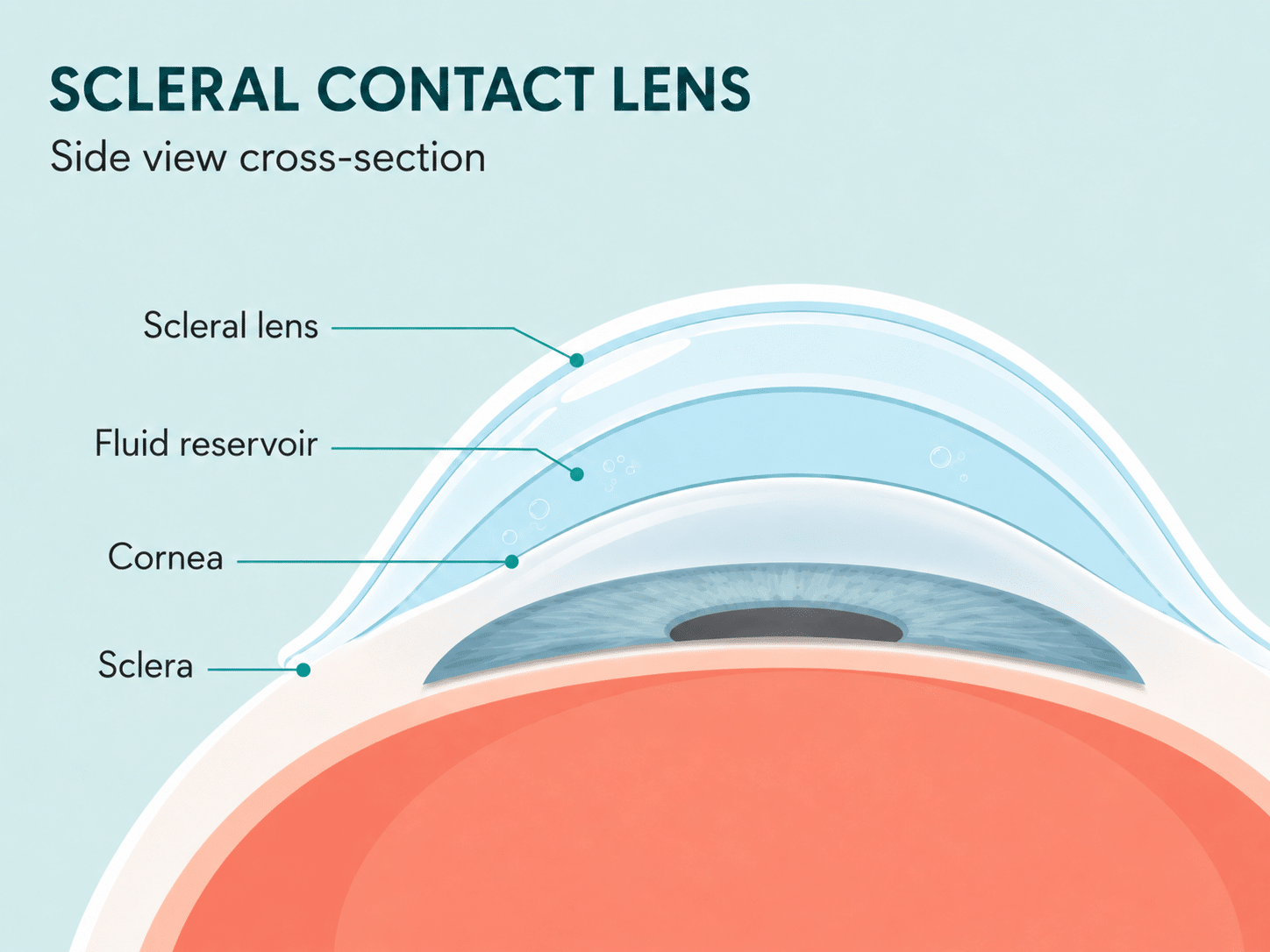
It's the closest thing in eyecare to wearing a humidifier on your eye.
"Wearing a humidifier on your eye" is the closest patient-facing description we've found. It's not perfect (sclerals do more than just hydrate), but it captures the part that matters: the cornea finally has somewhere to rest.
When scleral lenses are the right answer.
Sclerals are not a first-line dry eye treatment. They're a strong consideration when one or more of these are true:
You have an autoimmune cause
Sjögren's syndrome, rheumatoid arthritis, lupus, GVHD after bone marrow transplant. The underlying disease attacks the tear glands themselves, and drops alone often can't replace what's missing. Sclerals are often a useful tool in these cases.
You have ocular surface damage
Persistent epithelial defects, severe filamentary keratitis, neurotrophic keratopathy. The cornea has trouble healing while it's exposed to air and blinking. Sclerals can create a moist, protected environment that supports healing.
Post-LASIK dry eye that hasn't resolved
For most LASIK patients, dry eye resolves within months. For a small subset, it doesn't, and the corneal nerve damage can leave the eyes chronically uncomfortable. Sclerals are often the answer when nothing else has worked.
Severe MGD that hasn't responded
When meibomian gland dysfunction is advanced enough that the lipid layer can't hold the tear film together, and IPL, LipiFlow, manual expression, and prescription therapy haven't been enough, sclerals can give the surface the rest it needs.
How a scleral fit for dry eye works.
The process for severe dry eye is similar to any scleral fit, but with extra attention to fluid reservoir depth, lens diameter, and edge interaction with the conjunctiva, all of which matter more when the eye surface is already inflamed.
-
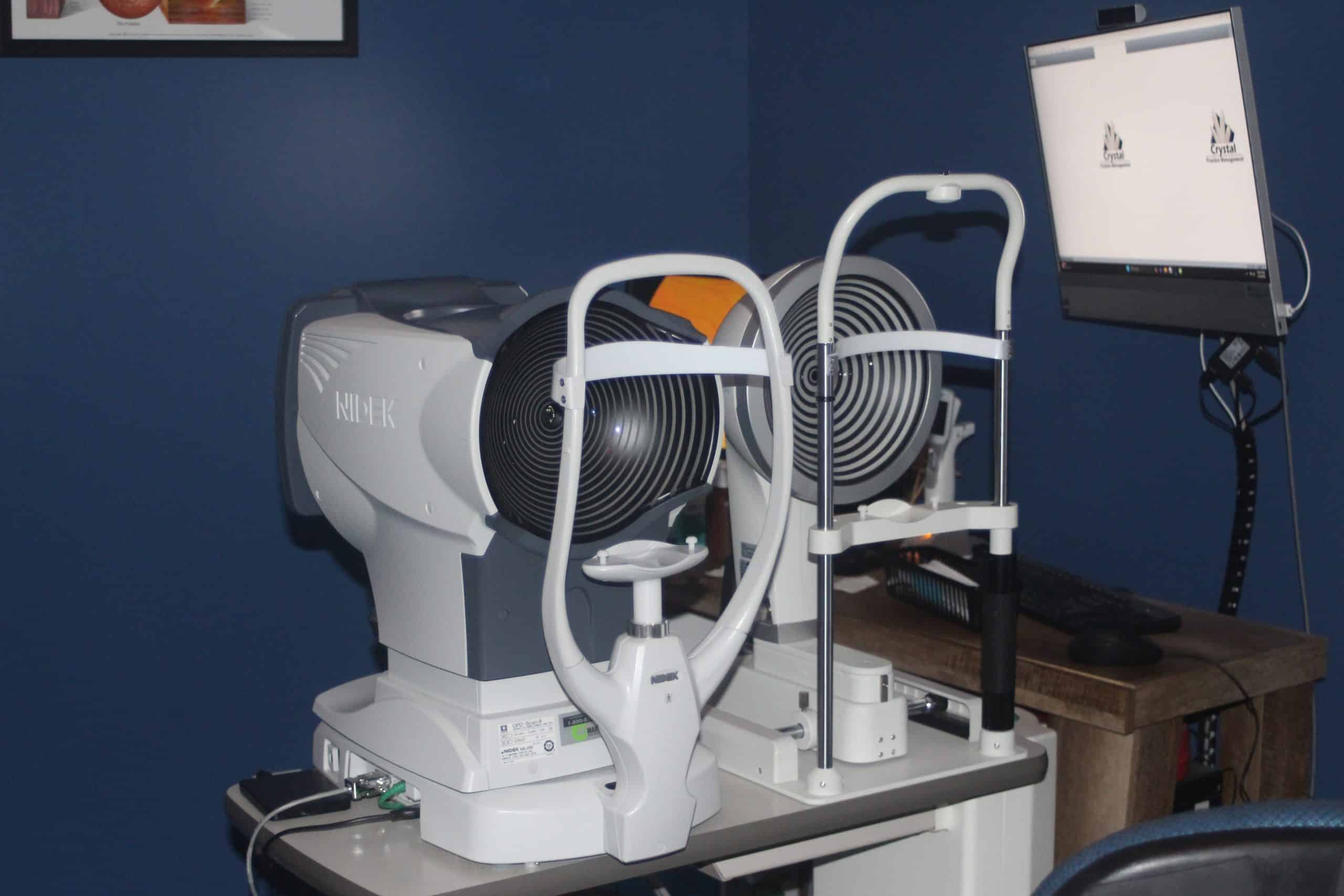
01Routine eye exam plus corneal topography on the Oculus Keratograph 5M. Maps your corneal surface and gives us baseline imaging of the meibomian glands and tear film.
-
02Anterior segment OCT. Cross-sectional imaging that lets us see exactly how the lens vaults the cornea and how deep the saline reservoir sits, critical for dry eye fits.
-
03Lens platform selection. Most dry eye fits go to Zenlens® (diagnostic-trial workflow) or WAVE ScleraLens® (built directly from your topography map). The choice depends on your corneal shape and what we see on imaging.
-
04Custom lens design. The lab manufactures to our specifications.
-
05Dispense and refinement. Most dry eye fits take 2–4 lens revisions to land on the final design. The fitting fee covers all of those revisions; you do not pay per iteration.

Why two lens platforms: Zenlens® and WAVE ScleraLens®.
Most scleral practices fit one lens line. We use both, deliberately, because they're built around fundamentally different design philosophies.
Zenlens®: diagnostic-trial workflow
A diagnostic lens from our trial set goes on your eye. We evaluate the fit in real time (vault, landing on the sclera, edge clearance), then refine the order based on what we see. Strong choice for many dry eye fits, especially when corneal shape is reasonably regular.
WAVE ScleraLens®: built from your map
No diagnostic trial. The lens is designed in CAD/CAM software directly from your corneal topography and manufactured to that exact design from the ground up. WAVE has been doing topography-driven scleral design since 1999. This is often the right call when the cornea has been damaged by long-standing surface disease and a stock trial lens won't represent the final fit well.
Having both platforms in-house means we pick the right tool for your eye, not the only tool we happen to carry.
A saline layer, all day
Preservative-free saline trapped between lens and cornea.
Two scleral platforms in-house
Zenlens® and WAVE ScleraLens®.
All fitting revisions included
You do not pay per iteration.
What scleral lenses don't do.
Sclerals are a tool. They're not a cure.
They do not treat the underlying disease driving your dry eye. Sjögren's still needs systemic management with your rheumatologist. MGD still benefits from lid hygiene, omega-3s, and in-office therapies. GVHD still needs your oncology team. Post-LASIK neurotrophic dry eye may still need ongoing therapy alongside the lenses.
What sclerals do is buy your cornea the protection it needs to function (and often heal) while the underlying condition is being managed elsewhere. The patients who do best are the ones who keep up with their other treatments and use sclerals on top, not instead.
What it actually feels like.
First insertion
First insertion is the hardest moment. You're using a small plunger or scleral ring, holding a lens full of saline, tilting your head. We spend as much time as you need teaching this. Once the lens is on, many dry eye patients describe noticeable relief: the burning eases and the foreign-body sensation tends to settle. Patients often describe the relief as immediate and memorable.
Settling in
Insertion gets faster. Most patients report comfort that holds through 8–12 hours of wear. Some severe-disease patients refresh the saline midday (pop the lens out, rinse, refill, reinsert) to keep things fresh. Others wear straight through.
Healing in place
Insertion takes seconds. Routine is established. Many patients report needing fewer drops between wears than they did before. The cornea is healing because it finally has somewhere to rest. We see you back at one week, one month, three months, and six months to confirm the fit and check the corneal surface.
What scleral lenses for severe dry eye cost at COVE.
Severe dry eye fits are a medical-necessity scleral fit. For most patients with major vision insurance, total out-of-pocket lands much lower than the sticker price.
Severe dry eye scleral fit
Includes corneal topography, anterior segment OCT, lens design, dispense visit, and the full follow-up schedule. All lens revisions during the fitting period are included. You do not pay per iteration.
- If you have VSP or EyeMed, your out-of-pocket is usually just a small copay. Most VSP and EyeMed plans include a Medically Necessary Contact Lens benefit that applies to severe dry eye fits. When it does, the fitting and the lenses are largely covered. Coverage rules vary by plan, and qualification depends on diagnosis criteria we'll work through at the appointment. Call us with your insurance card; we verify what we can in advance.
- For coverage, the dry eye usually needs to be documented as severe and unresponsive to standard therapy. Many patients we see already have substantial documentation (they've been escalating treatment for years), but qualification depends on plan criteria we work through at the consultation.
- All scleral lens costs are FSA and HSA eligible.
- We recommend annual lens replacement.
Why patients with severe dry eye come to COVE.
Dr. Matthew Karres has years of clinical experience designing and fitting specialty contact lenses at COVE: scleral, gas-permeable, multifocal, and orthokeratology fits. His research interests within specialty contacts are focused on scleral lens solutions, including for severe dry eye. Severe dry eye is one of the conditions that depth was built for.
What that means in practice:
-
i.Topography- and OCT-driven custom design. Every dry eye fit at COVE starts on the Oculus Keratograph 5M and is informed by anterior segment OCT imaging. We don't fit off a paper prescription; we fit off your actual eye.
-
ii.Two trusted lens platforms. Zenlens® (diagnostic-trial workflow) and WAVE ScleraLens® (built directly from your topography map). Different cases call for different platforms.
-
iii.Coordinated care with your other providers. Severe dry eye almost always involves more than one specialist. We work with your rheumatologist, oncologist, or LASIK surgeon as needed so the lens fit complements, rather than duplicates, the rest of your treatment plan.
-
iv.We don't pass off the hard cases. Persistent epithelial defects, post-transplant GVHD, neurotrophic corneas: these are exactly the fits we take on.
Severe dry eye fits are demanding. The lens has to vault enough to leave a fluid reservoir without sitting so high that it disrupts the conjunctiva. We design every fit with that balance in mind. When the first lens isn't right, we keep iterating at no extra fitting fee until it is.
What we ask of you: stick with the rest of your dry eye treatment plan, come to your follow-ups, and tell us specifically what's bothering you when something feels off. Patients who stay engaged get the best results.
Patients who'd been told "there's nothing else to try" for their dry eye are part of our 1,100+ five-star Google reviews. Reviewers with hard-to-fit prescriptions describe doctors who stay with the fit until it’s right, and appointments that don’t feel rushed.
“a next level experience” · “very thorough and patient on everything” · “I don’t trust anyone else with my eyes”
Read the reviews for yourself on Google →Frequently asked questions.
Q.01 Will I still need drops and other treatments if I wear sclerals? +
Q.02 Can I sleep in scleral lenses? +
Q.03 I have Sjögren's. Will sclerals help? +
Q.04 I had LASIK and my eyes have been dry ever since. Can sclerals help? +
Q.05 What if I wear sclerals and my dry eye still doesn't fully resolve? +
Q.06 How do I clean a scleral lens? +
Q.07 Will my insurance pay for this? +
Schedule a dry eye scleral consultation.
If you've been told there's "nothing else to try" for your dry eye, that isn't true. The next step is a corneal surface evaluation, topography scan, and a conversation about whether sclerals are likely to help in your situation. We can do all of that at your next routine eye exam.
Related reading: our scleral lens hub · sclerals for keratoconus · sclerals for irregular and post-surgical corneas