
Take a pair of glasses apart in 3D.
COVE built an interactive frame explorer. Spin the frame, drag the explode slider, and watch every piece drift apart with its name attached. Switch between a plastic frame and a metal one, then look at how the measurements are taken.
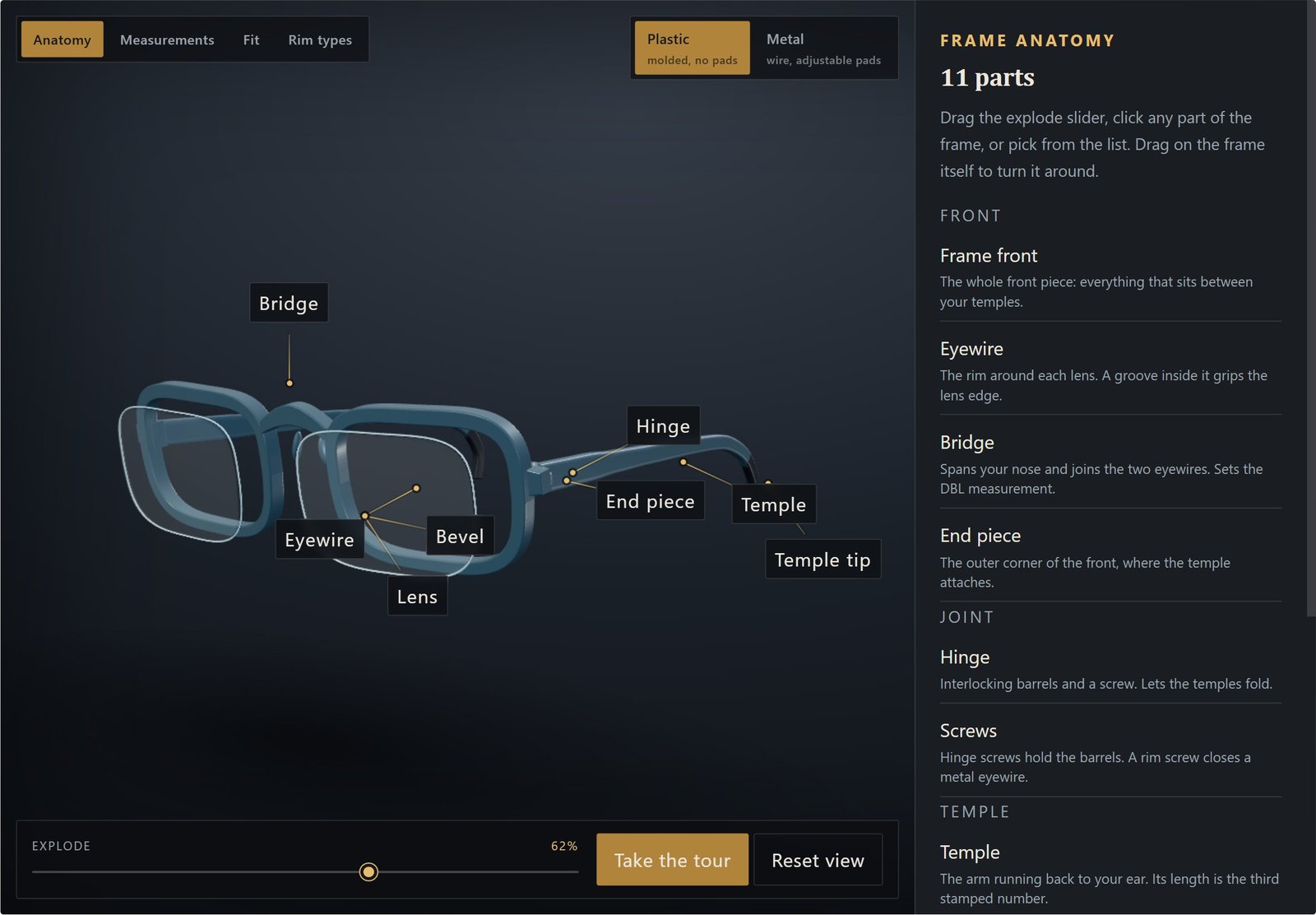
Four parts worth knowing before you go in.
Eyewire
The rim around each lens. Its inner groove holds a lens cut for that particular frame shape.
Bridge
The piece that crosses your nose. Its width and shape affect comfort and where the lenses sit.
Temple
The arm that runs from the hinge back past your ear. Its stamped length is fixed, but an optician can adjust the bend and drop behind the ear.
Nose pads
On many metal frames these sit on adjustable arms, and their position raises or lowers the whole frame.
The measurements behind a good pair of glasses.
The boxing system gives frame makers and optical labs a standard way to describe frame dimensions. Picture the smallest rectangle that can be drawn around one lens shape: its width and height become the reference measurements.
Pupillary distance, or PD, tells the lab where to center each lens in front of your eyes. Opticians often measure it separately for each eye, because faces are not perfectly symmetrical.
Fitting height positions the lens design vertically in the frame you chose. It matters most for progressive and other multifocal lenses.
Look inside either temple and you may find three numbers such as 54 ◻ 17 - 145. The first is the lens width, the second is the distance between the lenses (often called the bridge size), and the third is the temple length, all in millimeters. The small square is the boxing-system symbol.
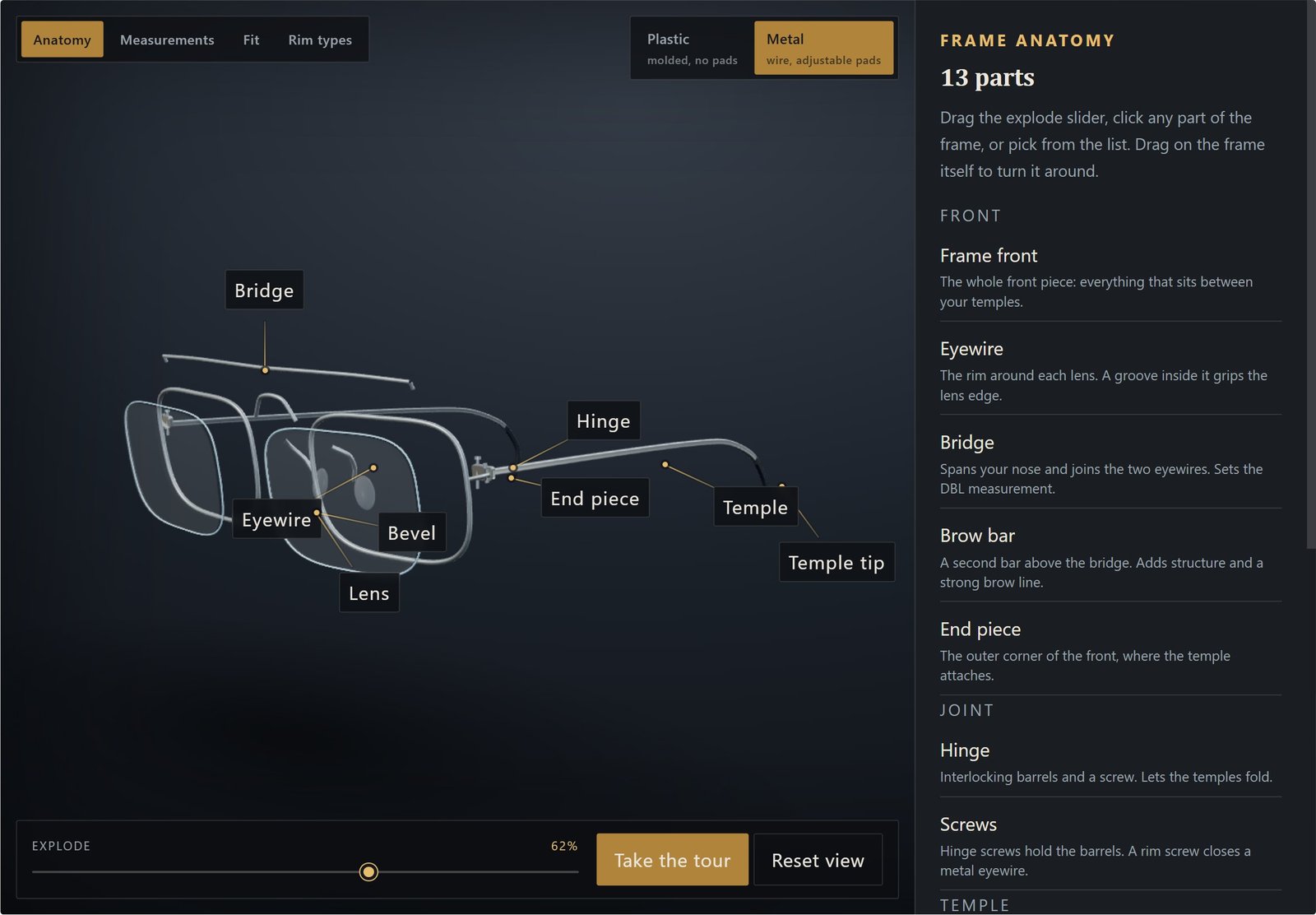
A metal frame comes apart differently. Flip between the two and see it.
Open the frame explorer →Common frame questions.
Can my current lenses go into a different frame?
Usually not. A lens is normally edged for one particular frame shape, and its measurements are based on where your eyes sit in that frame. An optician can sometimes recut an existing lens for a smaller shape.
Why do my glasses slide down even when the frame size looks right?
The printed size does not describe every contour of the nose, bridge, temples, or ears. Bridge fit, nose-pad position, temple bend, frame weight, and how the frame balances can all affect slipping.
Why can new glasses feel wrong when the prescription is correct?
The frame may need adjustment, or the lenses may not be sitting in the intended position relative to your eyes. Ask an optician to check the fit, PD, fitting height, and other measurements.
When the fit feels wrong.
Glasses that pinch, slip, sit crooked, or make your vision feel off deserve a closer look. Ask an optician to check both the frame adjustment and the lens measurements.