
Glasses built for the distance you actually work at.
Your regular glasses are made for far away or for reading up close. Your screen sits in between, and your eyes spend the whole day straining to bridge the gap. That's why so many people get tired eyes, headaches, and a stiff neck by mid-afternoon.
Computer and office lenses are built for that middle distance, so your eyes stop working overtime.
Why screens are hard on your eyes.
Two things happen when you work on a screen all day. Your eyes hold focus at a fixed middle distance for hours, and you blink less, which dries the surface. Regular distance glasses make the first problem worse, because they force your focusing muscles to do extra work to keep an intermediate screen clear. The fix isn't usually "more magnification," it's a lens built for where your screen actually is.
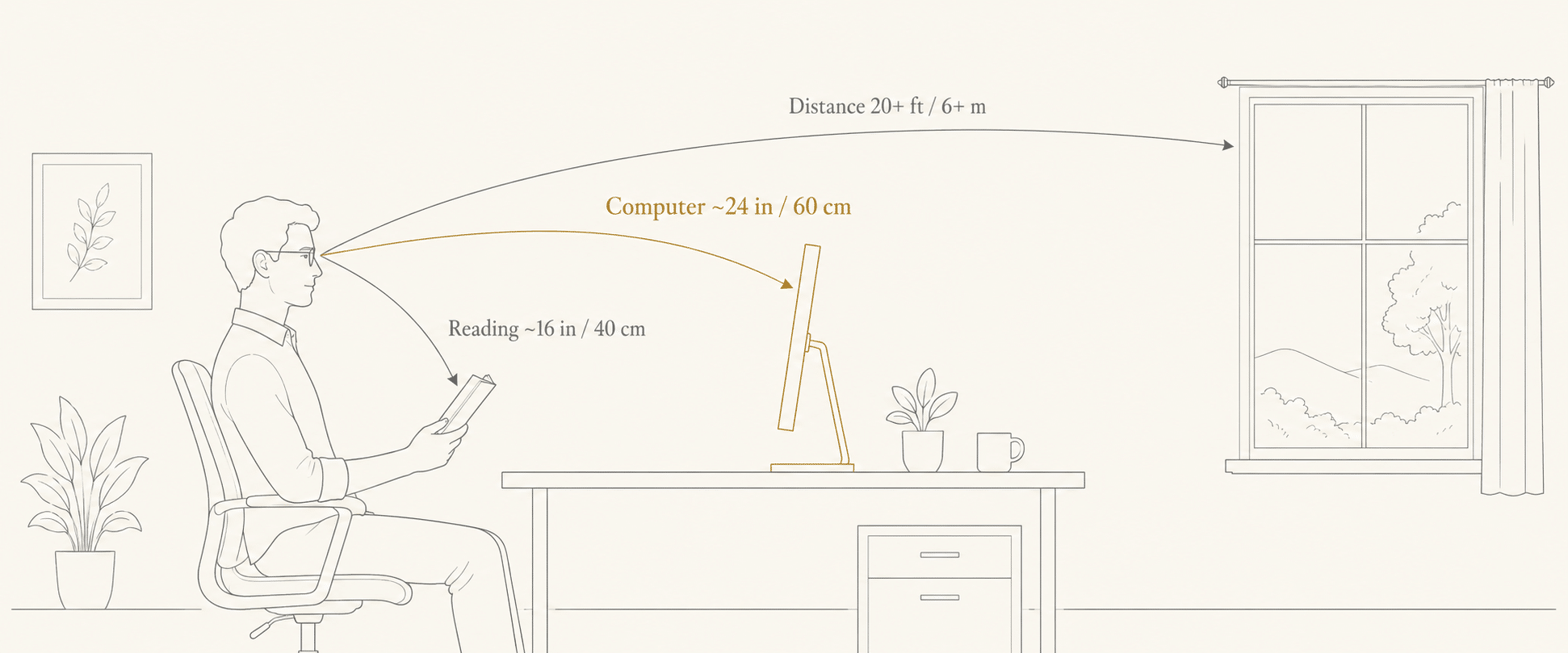
The lens options, matched to your day.
Single-vision computer lenses
The whole lens is set for your screen distance. Best for focused desk work.
Office / occupational lenses
A wider intermediate zone plus near, so you can see your monitor and your desk clearly without tipping your head back the way progressives can force you to. Great for people who split time between screen and paperwork.
Anti-fatigue lenses
A small boost in the lower part of the lens that takes some strain off the focusing muscles. A good fit for younger adults and students who aren't ready for a full reading correction but feel the fatigue.
We match the option to how you actually work, and we measure and finish them in our own lab.
How our in-house lab measures and finishes lenses →
A word on blue light.
You've seen blue-light filtering marketed hard. We'll be straight with you: the best available evidence says blue-light filtering lenses don't measurably reduce eye strain, and there's no research showing that the light from a screen damages your eyes. Most screen discomfort comes from the focusing and reduced blinking described above, not the light itself. We make blue-light filtering for anyone who wants it, and plenty of patients genuinely prefer it. We just don't push it, because the fix that actually works is a lens built for your working distance.
A 2023 Cochrane systematic review pooled 17 randomized trials covering 619 people and found that blue-light filtering lenses probably make little or no difference to eye strain, to vision, or to sleep quality. The American Academy of Ophthalmology does not recommend them either, on the grounds that there is no evidence the light coming from screens harms your eyes.
What is well documented is the part we actually build around. Your eyes hold a fixed intermediate focus for hours and you blink less, which dries the surface. The American Optometric Association recommends keeping your screen 20 to 28 inches away with the center about 4 to 5 inches below eye level, and taking 20 seconds every 20 minutes to look at something 20 feet away.
So we treat blue-light filtering as a preference, not a treatment. Some patients love it and would not go back; others try it and never notice a difference. Both are normal answers, and we are happy to help either way. If you want it, we carry current options that look like ordinary clear lenses rather than the yellow-tinted versions the category used to be known for. If you are hoping it protects your eyes over the long run, we do not have research to hand you, and we would rather say so than sell you on it.
The case for a dedicated pair.
Computer glasses work best as a second pair you keep at your desk, not your only glasses. That way your everyday pair stays optimized for everything else.
- We discount second pairs, which makes a dedicated computer pair an easy add.
- If you wear daily contacts, an annual supply comes with a free pair of single-vision lenses, which a lot of people turn into their computer pair.
About COVE Plus → · Everyday progressives →
Common questions.
Q.01 Are computer glasses just weak readers? +
No. They're built specifically for your screen distance and your prescription, not a one-size magnifier off a rack. The right power and the right measurement are what make them comfortable.
Q.02 Do I need a separate pair, or can my progressives do this? +
Progressives can handle a screen in a pinch, but the intermediate zone is narrow and often makes you tip your head. For all-day screen work, a dedicated computer or office lens is far more comfortable.
Q.03 Do blue-light glasses actually work? +
Probably not for eye strain. A 2023 Cochrane review of 17 randomized trials found blue-light filtering lenses make little or no difference to eye strain, vision, or sleep, and there is no research showing screen light damages your eyes. Most screen strain is about focusing distance and blinking less. That said, some patients genuinely prefer the filter, so we make it for anyone who wants it, in current options without the old yellow tint. We just build the working-distance lens first.
Q.04 What about dry, tired eyes from screens? +
Some of that is the reduced blinking that comes with screen focus. If dryness is a bigger issue, mention it at your exam and we'll take a look.
Q.05 Can I use insurance? +
It depends on your specific plan and the eyewear benefits it includes. We accept VSP and EyeMed and verify your plan before you order. We also discount second pairs, and if you have a vision plan we apply whatever second-pair benefit it includes.
Stop fighting your screen all day.
Tell us how you work and we'll build a lens for it, measured and finished in our own lab.
Related reading: How we make glasses in-house → · Progressive lenses → · Frame brands we carry → · Glasses overview →