Orthokeratology in New Albany, Ohio.
Ortho-k lenses are rigid, gas-permeable contacts you wear only at night. While you sleep, they gently flatten the cornea into a new shape. You remove them in the morning and see clearly all day, with nothing in your eyes. It works for nearsightedness, moderate astigmatism, and mixed prescriptions, and it has a second major benefit for kids: it's one of the most effective tools for slowing myopia progression.
COVE has been fitting ortho-k since we opened. Dr. Karres has years of clinical experience designing and fitting specialty contact lenses at COVE: scleral, gas-permeable, multifocal, and orthokeratology fits. When ortho-k is the right answer for your eyes, you're in the right place.
What orthokeratology actually does.
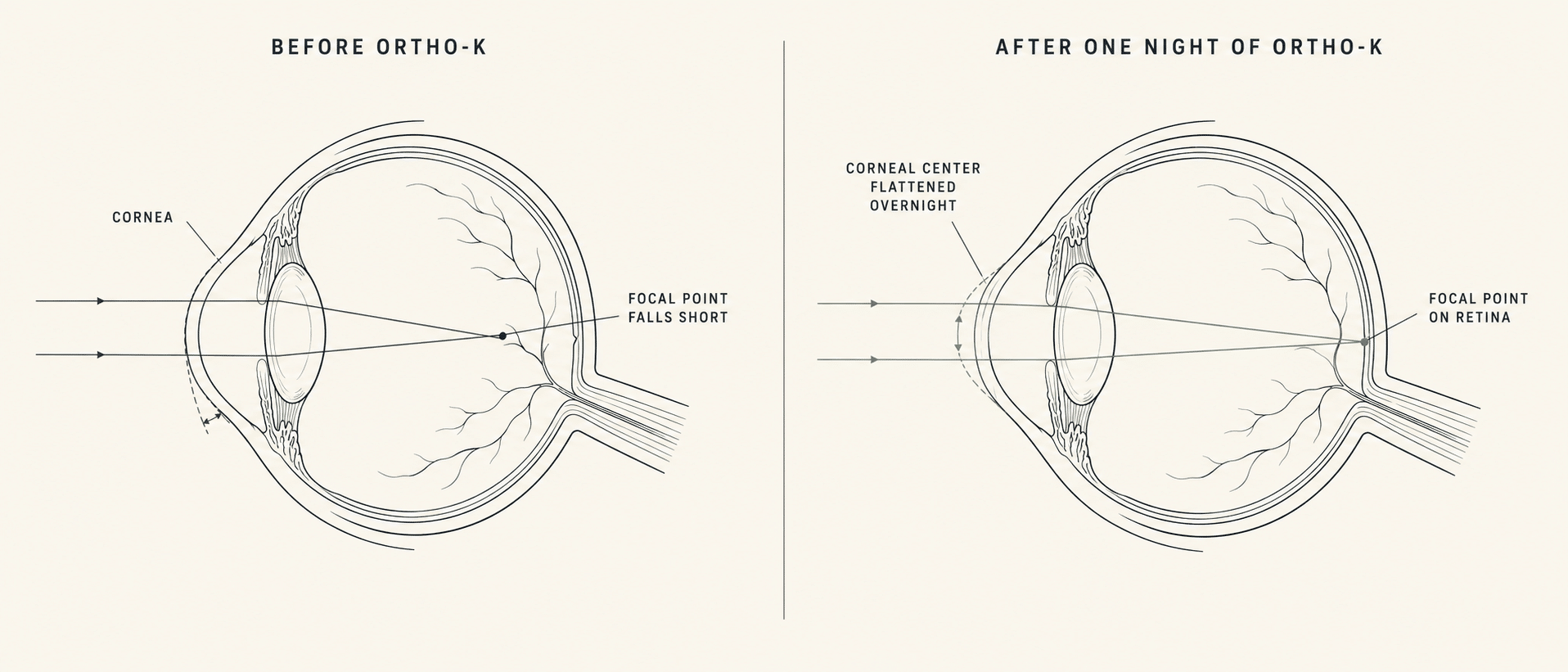
Ortho-k lenses are engineered to temporarily change the shape of your cornea. Your cornea is the clear dome at the front of the eye: it does most of the focusing work. In a nearsighted eye, the cornea is too steep, bending light to a focus point in front of the retina instead of on it. Ortho-k lenses apply a precise, gentle pressure while you sleep that flattens the central cornea into the right curvature. By morning, the new shape holds: for most patients, 16 to 24 hours of clear vision on a single night's wear.
The correction is fully reversible. If you stop wearing the lenses, your cornea returns to its original shape within a few days. There is no surgery, no recovery period, no permanent commitment.
For kids, ortho-k does something additional: wearing the lenses at night appears to slow the axial elongation (the eye growing longer) that drives myopia progression. This matters because a higher prescription in adulthood raises the lifetime risk of serious eye disease, including retinal detachment, maculopathy, and earlier cataracts. Slowing that progression now reduces that risk later.
Four audiences. Four deeper dives.
Ortho-k is not one-size-fits-all. The reason you'd choose it matters, and the considerations for a 10-year-old with progressing myopia are different from those for an adult swimmer or someone exploring LASIK alternatives. We've written a focused page for each audience.
Children & myopia control
Kids ages 6 and up can wear ortho-k lenses. For a child whose prescription is changing every year, ortho-k is a well-studied option: studies show it may meaningfully slow myopia progression compared to single-vision glasses. Dr. Keller has particular depth in pediatric care, and our myopia management program covers every option so you're comparing, not just choosing whatever one office happens to offer.
Non-surgical freedom
If you're tired of glasses and not ready for (or not eligible for) surgery, ortho-k is the clearest non-surgical alternative. Wear lenses at night, see clearly during the day, and do anything else without reaching for your glasses. The tradeoff is real: you do need to wear the lenses consistently every night to maintain the effect.
Nothing in your eyes all day
Ortho-k is one of the most practical vision-correction options for competitive swimmers, wrestlers, martial artists, and anyone else whose sport makes contacts impractical and glasses impossible. Nothing in your eyes during the day means nothing to lose, nothing to worry about, and no chlorine exposure on a contact lens.
Reversible correction
Some patients aren't LASIK candidates: thin corneas, dry eye, prescription out of range. Others simply prefer a reversible option. Ortho-k can correct many common nearsighted prescriptions without surgery; LASIK covers a different and often broader surgical range. We walk through the comparison honestly: we don't perform LASIK and have no financial stake in pushing you toward it.
What the evaluation includes.
The first step is a no-charge evaluation that includes corneal topography. This is the imaging that makes a custom ortho-k fit possible. It maps your corneal curvature, elevation, and surface shape down to the micron, and we use an Oculus Keratograph 5M for it, the same instrument we use for scleral lens fitting.
During the evaluation, we'll confirm whether you're a good ortho-k candidate, walk through what the lenses feel like and what to expect in the first few weeks, and give you an honest cost estimate before you commit to anything.
One scheduling note: if it's been about six months or more since your last eye exam, a current exam (a normal billed visit) may need to come first so the doctors know where your eyes are starting from.
If you decide to move forward: custom lenses are designed from your topography map and typically arrive from the lab within a week. We teach insertion and removal at a dispense visit: this takes as long as it takes. Follow-up appointments at 1 week, 1 month, 3 months, and 6 months are included in the first year's fee, and so are any lens refinements needed along the way.
Some patients notice significant vision improvement after a single night of wear. Most reach their stable prescription within 2 to 3 weeks. During the adjustment period, you can wear your glasses or daily soft lenses during the day.
What ortho-k costs at COVE.
The first-year program starts around $800 and can run up to about $2,000, depending on your prescription and lens design. That first-year fee covers two custom lenses, all follow-up appointments, and any lens modifications. If you have VSP or EyeMed, your benefits may lower that cost. We verify your benefits in advance and give you the clearest estimate we can before your evaluation.
FSA and HSA funds are eligible for ortho-k costs.
- Two custom ortho-k lenses designed from your corneal topography
- All scheduled follow-up visits (1 week, 1 month, 3 months, 6 months)
- Lens refinements and adjustments if the design needs modification
- Insurance verification before your first appointment: we share the clearest estimate we can in advance
Why patients choose us for ortho-k.
Dr. Karres has years of clinical experience designing and fitting specialty contact lenses at COVE, including orthokeratology. This is not a service COVE added to the menu; it's one of the things we do well.
-
i.Clinical depth in ortho-k. Dr. Karres has fit ortho-k cases across the prescription range over years of clinical practice. He understands the optics behind the fit, not just the fitting protocol.
-
ii.We fit kids. Dr. Keller has worked with pediatric patients throughout her career. She is an InfantSEE provider and has taught vision education to more than 13,000 Ohio students through the Realeyes program. A child who comes in nervous about wearing contact lenses is in the right room.
-
iii.The free topography consultation is a real appointment, not a sales call. We run the imaging, interpret it, and tell you honestly whether ortho-k is the right answer for your eyes. If it's not, we'll tell you that too, and tell you what is.
-
iv.Everything is included in the first year. Lens refinements, follow-up appointments, adjustments: all part of the fee. We don't cut the process short to protect a margin.
Ortho-k works when the lens design is right for your cornea and you wear it consistently. We do our part: careful topography, a custom-designed lens, and follow-ups at every milestone. We keep iterating if something's off, at no extra fitting charge.
What we ask of you: wear the lenses as prescribed, show up to follow-ups, and tell us specifically what's bothering you when something feels wrong. That exchange is what gets you to clear vision faster.
More than 1,100 five-star Google reviews, and the ortho-k families in them tell the story themselves: kids with strong prescriptions seeing 20/20 all day without glasses, and families who moved out of state and still come back every year for their children’s ortho-k care.
“couldn’t be more thrilled” · “worth the drive”
Read the reviews for yourself on Google →Schedule your no-charge ortho-k evaluation.
We see patients from New Albany, Gahanna, Westerville, Johnstown, and across Central Ohio. The first step is a no-charge evaluation with corneal topography. It costs you nothing and tells you whether ortho-k is right for your eyes. One note: if your last eye exam was six months ago or more, a current exam (a normal billed visit) may need to come first so the doctors know where your eyes are starting from.